
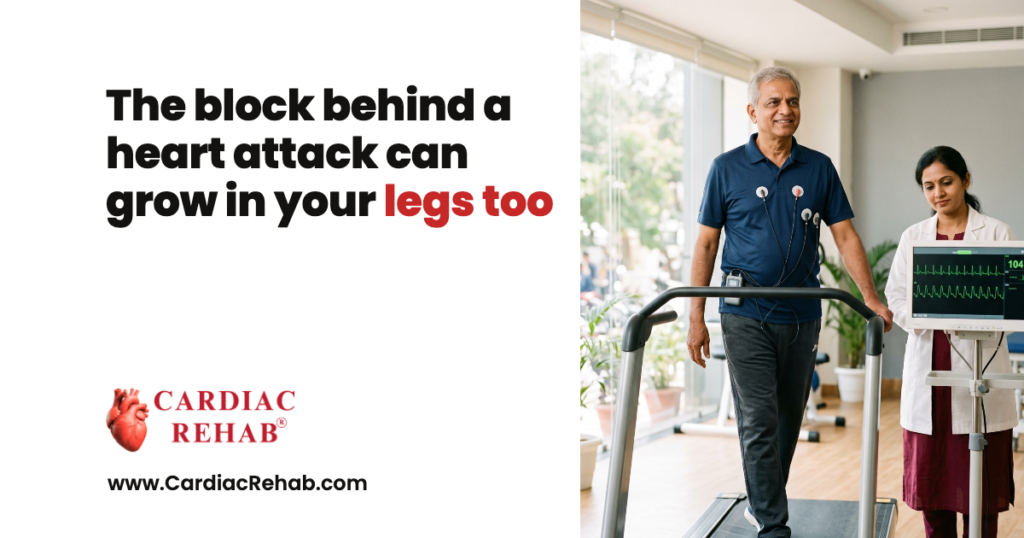
Short answer: Leg artery disease (PVD or PAD) is the same blockage that causes heart attacks, but in the legs. It causes calf pain when you walk. The 2024 American guideline gives supervised exercise its top grade, both when you have symptoms and after a stent. Training does not melt the block. But the arteries soften and can widen around it, and the muscle learns to do more with the blood it gets.
In this article
- Leg artery disease is the same kind of block as a heart attack, in the legs.
- Training softens stiff arteries, and can widen them.
- Supervised exercise helped people walk further than a stent in one trial.
- After a stent, the guideline still gives exercise its top grade.
- Cardiac rehab gives this exercise safely, with your heart watched.
What does the news say?
On 1 October, the Hindustan Times spoke to vascular surgeon Dr Rajiv Parakh of Medanta about peripheral vascular disease. He warned that it is often missed. People blame leg pain on age, weak bones or the knees, and see the wrong doctor. The article lists medicines, balloons, stents and other procedures as treatment.
What the article does not mention is exercise. Yet exercise is one of the best tested treatments for this disease. This post explains how it works, and where physician supervised, exercise based cardiac rehab fits in.
What is leg artery disease?
A heart attack happens when a heart artery is blocked by fatty plaque. The same plaque can build up in the arteries of the legs. Doctors call all of this peripheral vascular disease, or PVD. You may also hear peripheral artery disease, or PAD. Around 202 million people had it in 2010, 54.8 million of them in southeast Asia (Fowkes, Lancet, 2013).
The causes are almost the same as for a heart attack. Smoking, diabetes, high blood pressure and high cholesterol all raised the risk in that study. Dr Parakh points out that it rarely stays in the legs. The same disease reaches the arteries of the heart, brain and kidneys too. So the legs are often a warning for the heart.
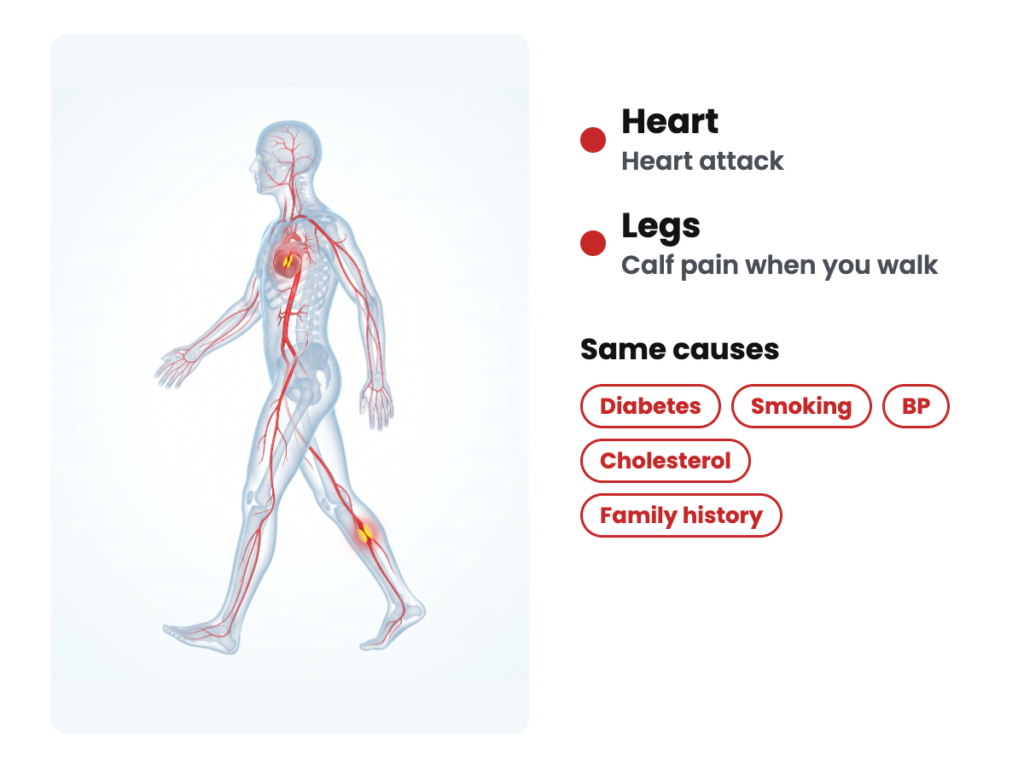
The classic sign is calf pain when you walk. It makes you stop, it eases with rest, and it comes back at the same distance. Doctors call this claudication. The article lists other signs too: a cold foot, wounds that do not heal, and shiny, dry or hairless skin on the legs.
A simple test compares the blood pressure in your arms and your ankles. Doctors call it the ABI test. A Doppler scan can then show where the artery is narrowed. If you have diabetes or smoke, ask for your legs to be checked.
How does exercise change the arteries?
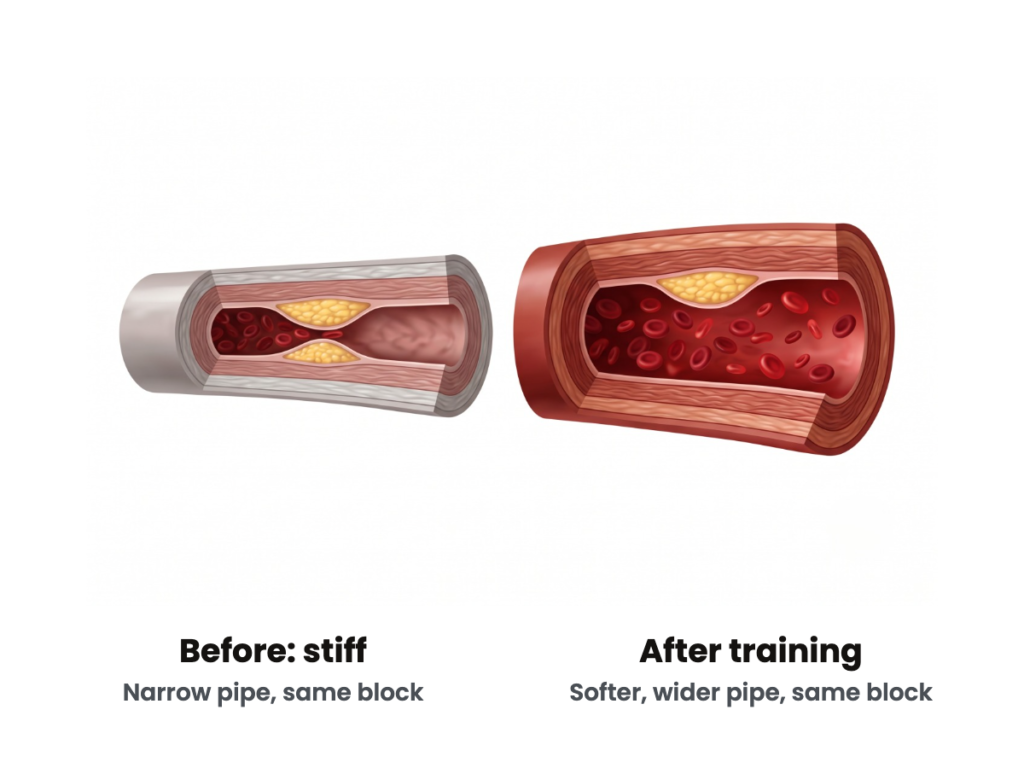
The block itself does not melt away. What changes is the artery around it and the muscle it feeds. Young, healthy arteries are soft and stretch with each heartbeat. Old, diseased arteries turn stiff. Exercise works on both stiffness and size.
The arteries soften
A review of 79 studies found that aerobic training made arteries less stiff (Bakali, Open Heart, 2023). A trial of 72 people with leg artery disease found the same. Twelve weeks of walking in water made their leg arteries less stiff (Park, J Appl Physiol, 2019). A softer artery stretches with each pulse instead of fighting it.
The arteries can widen
During exercise, blood rushes through the arteries and pushes on their walls. Arteries answer that push over months by changing their lining, their wall and even their size (Green, Physiol Rev, 2017). In 40 people with leg artery disease, only those in supervised training had a wider deep thigh artery after about seven months. The wider it got, the further they walked (Dopheide, Eur J Prev Cardiol, 2017).
A wider, softer artery means the same block takes up less of the pipe. That is one reason people walk further. The 2024 guideline adds a fair note. Most studies have not measured more blood flow through the leg, so the muscle changes below matter too (Gornik, JACC, 2024).
The muscle does more with less
Training adds and improves the muscle’s power stations, the mitochondria. The calf learns to make more energy from the oxygen it gets. So the same blood carries you further before the pain starts (Hamburg and Balady, Circulation, 2011).
The artery lining relaxes better
The inner lining of the artery releases nitric oxide, which helps it widen. Exercise improves this. Training also lowers markers of inflammation in the blood. Small new vessels may grow too, but this is shown mostly in animals.
Can exercise stop the block growing?
The block grows from the same causes that started it: high sugar, high cholesterol, high BP and smoking. Exercise brings several of these down. A 1992 trial followed 113 people with blocked heart arteries. A year of exercise with a low-fat diet cut cholesterol by 10% and weight by 5%.
The blocks grew in 23% of that group, against 48% on usual care. They shrank in 32%, against 17% (Schuler, Circulation, 1992). That trial was in heart arteries and included diet. But it is the same disease, driven by the same causes. Cardiac rehab works on all of them at once.
What does the proof show?
A Cochrane review of 32 trials with 1,835 people found exercise added about 82 metres of walking before pain, and about 120 metres of total walking. The gains lasted up to two years (Lane, Cochrane, 2017). The people in these trials had calf pain on walking, the sign described above.
The CLEVER trial compared exercise with a stent. After six months, supervised exercise added 5.8 minutes of treadmill walking, a stent 3.7 minutes, and medicines alone 1.2 minutes. People with a stent did report a bigger lift in daily life, so both have a place (Murphy, Circulation, 2012).
A procedure opens the pipe, but the muscle still needs training. In the ERASE trial, people given a stent and then supervised exercise gained 1,237 metres of walking in a year. Supervised exercise alone gained 955 metres. The two together did best (Fakhry, JAMA, 2015).
The 2024 guideline gives supervised exercise after a procedure its top grade. It also says exercise should be offered as a first treatment for leg pain on walking. In both cases, physician supervised, exercise based cardiac rehab is a safe place to do it. The same disease often reaches the heart too.
Why supervised?
The guideline says the best results come from walking until mild or moderate pain, resting, and walking again. Done alone, people stop too early or push too hard. In cardiac rehab, we set your pace, watch your heart and BP, and raise the work week by week. For runners and walkers, the same story is told on the Telangana Runners blog.
Your questions, answered
Is leg pain on walking always from the knees?
No. Calf pain that comes on with walking, eases with rest and returns at the same distance can come from blocked leg arteries. It is often blamed on age or the knees. A simple test of arm and ankle blood pressure can tell the difference. Ask your doctor if you have diabetes or smoke.
Does exercise open a blocked leg artery?
Exercise does not melt the block. But arteries become softer with training, and in one study the deep thigh artery grew wider with supervised exercise. The muscle also makes more energy from the blood it gets. So people walk further, even with the same block.
Do I still need exercise after a stent?
Yes. In the ERASE trial, a stent plus supervised exercise added more walking than exercise alone. The 2024 guideline gives exercise after a leg procedure its top grade. The stent opens the pipe; training builds the muscle that uses it.
Is it safe to walk if my legs hurt?
Walking to mild or moderate pain, then resting, is how the treatment works. It should be planned by a doctor, because many people with blocked leg arteries also have heart disease. In supervised cardiac rehab, your heart and BP are watched while you train.
Cardiac rehab is the answer for PVD
Physician supervised, exercise based cardiac rehab runs at our clinic in Film Nagar, Jubilee Hills, Hyderabad. Join Cardiac Rehab. Write to info@cardiacrehab.com, visit www.CardiacRehab.com, or message us on WhatsApp. Want to see how walking itself saves energy? Read You have never walked in a straight line.
info@cardiacrehab.com · www.CardiacRehab.com
Cardiac Rehab, 7B Journalist Colony, Film Nagar, Jubilee Hills, Hyderabad, Telangana 500096
References
- Dogra T. Peripheral vascular disease (PVD): Vascular surgeon Dr Rajiv Parakh explains the symptoms, risks, prevention, treatment. Hindustan Times, 1 October 2026. hindustantimes.com/lifestyle/health/peripheral-vascular-disease-pvd-vascular-surgeon-dr-rajiv-parakh-explains-the-symptoms-risks-prevention-treatment-101790261231853.html
- Fowkes FG, et al. Comparison of global estimates of prevalence and risk factors for peripheral artery disease in 2000 and 2010. Lancet. 2013;382:1329-40. pubmed.ncbi.nlm.nih.gov/23915883
- Gornik HL, et al. 2024 ACC/AHA Guideline for the Management of Lower Extremity Peripheral Artery Disease. J Am Coll Cardiol. 2024;83:2497-2604. pubmed.ncbi.nlm.nih.gov/38752899
- Bakali M, et al. Effect of aerobic exercise training on pulse wave velocity in adults with and without long-term conditions: a systematic review and meta-analysis. Open Heart. 2023;10:e002384. pubmed.ncbi.nlm.nih.gov/38101857
- Park SY, et al. Impacts of aquatic walking on arterial stiffness, exercise tolerance, and physical function in patients with peripheral artery disease: a randomized clinical trial. J Appl Physiol. 2019;127:940-949. pubmed.ncbi.nlm.nih.gov/31369328
- Green DJ, Hopman MTE, Padilla J, Laughlin MH. Vascular adaptation to exercise in humans: role of hemodynamic stimuli. Physiol Rev. 2017. pubmed.ncbi.nlm.nih.gov/28151424
- Dopheide JF, et al. Supervised exercise training in peripheral arterial disease increases vascular shear stress and profunda femoral artery diameter. Eur J Prev Cardiol. 2017;24:178-191. pubmed.ncbi.nlm.nih.gov/27550906
- Hamburg NM, Balady GJ. Exercise rehabilitation in peripheral artery disease: functional impact and mechanisms of benefits. Circulation. 2011;123:87-97. pubmed.ncbi.nlm.nih.gov/21200015
- Schuler G, Hambrecht R, et al. Regular physical exercise and low-fat diet. Effects on progression of coronary artery disease. Circulation. 1992;86:1-11. pubmed.ncbi.nlm.nih.gov/1617762
- Lane R, Harwood A, Watson L, Leng GC. Exercise for intermittent claudication. Cochrane Database Syst Rev. 2017;12:CD000990. pubmed.ncbi.nlm.nih.gov/29278423
- Murphy TP, et al. Supervised exercise versus primary stenting for claudication (CLEVER): six-month outcomes. Circulation. 2012;125:130-9. pubmed.ncbi.nlm.nih.gov/22090168
- Fakhry F, et al. Endovascular revascularization and supervised exercise for peripheral artery disease and intermittent claudication (ERASE). JAMA. 2015. pubmed.ncbi.nlm.nih.gov/26547465