
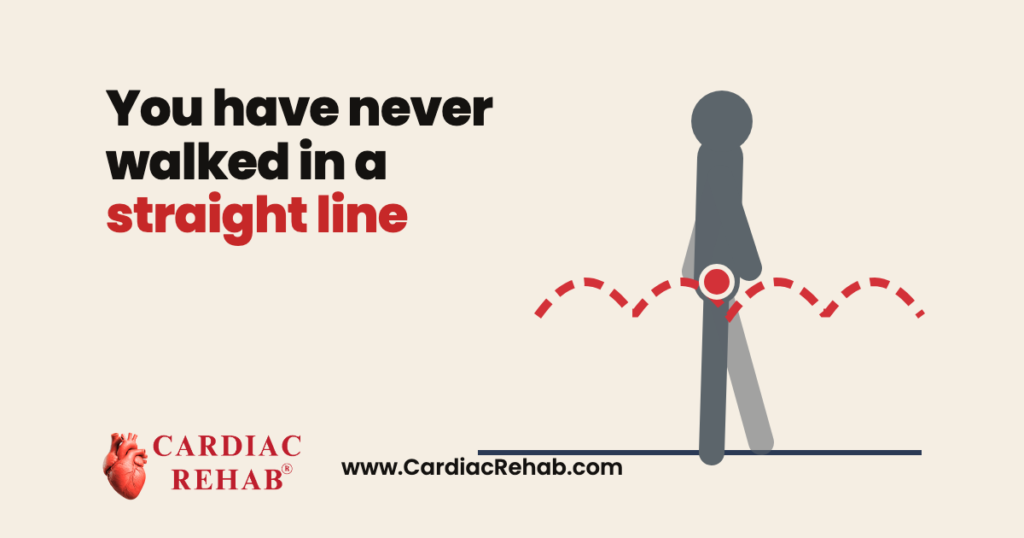
Short answer: When you walk, your body’s centre of gravity does not move in a straight line. It rises and falls a few centimetres with every step, and sways over each foot. This wave works like a pendulum, so about 65% of the energy is used again each step (Cavagna, 1977). Less energy per step means less work for your heart.
In this article
- Your centre of gravity moves in a wave: up and down, and left to right.
- Going up turns speed into height. Coming down turns it back into speed.
- This pendulum trick reuses about 65% of the energy in each step.
- Your natural side-to-side sway costs the least energy.
- Cardiac rehab builds walking safely, so your heart gets the full benefit.
What is your centre of gravity?
Your centre of gravity is the one point where your whole body’s weight balances. When you stand, it sits a little below your belly button. When you walk, it moves with you, and it carries your whole body’s weight from step to step.
Most people think it glides forward in a straight line, like a train on a rail. It does not. Gait scientists have shown that it moves in a smooth wave, in two directions at once (Saunders, Inman and Eberhart, 1953).
Which way does it move?
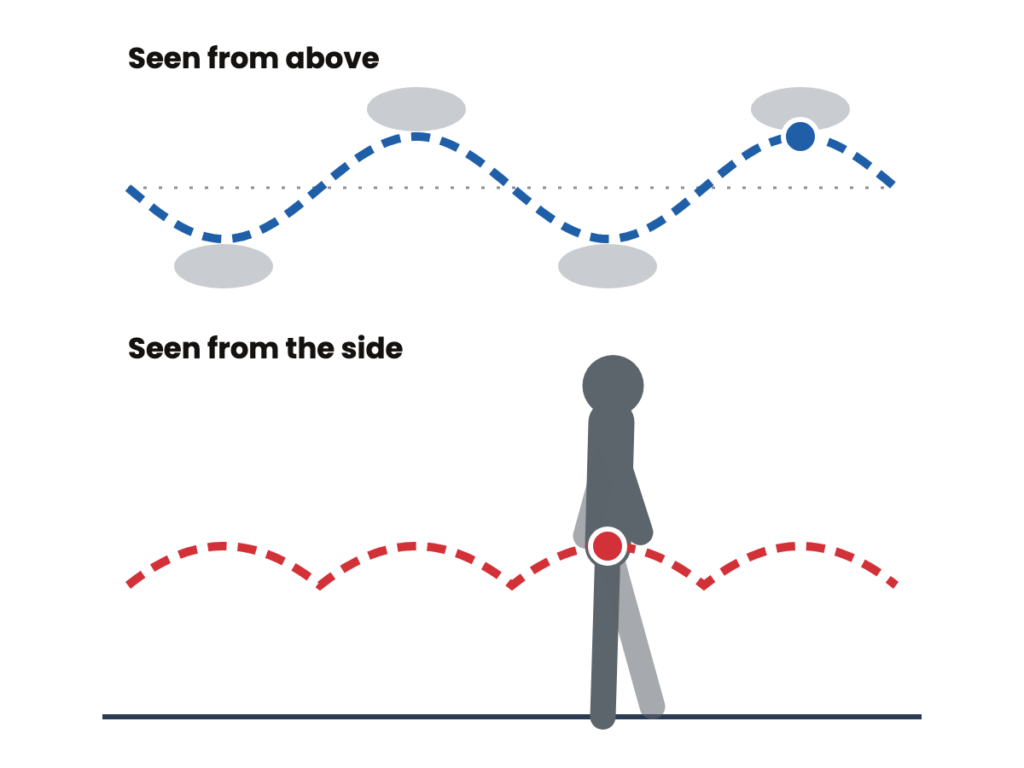
It moves in two directions at the same time. The first is up and down, once with every step. The second is left to right, once for every two steps.
Up and down
With each step, your body rises over the foot on the ground, then comes down into the next step. Studies measure this rise at a few centimetres, about 4 to 5 cm at normal walking speed. Your leg acts like an upside-down pendulum, with your foot as the pivot (Kuo and Donelan, 2010).
Left and right
You stand on one foot at a time, so your weight shifts over each foot in turn. Seen from above, your centre draws a gentle S-shape, one curve for every two steps. This shift is small, only a few centimetres, and you never feel it.
Why does a wave save energy?
Think of a steel ball rolling down two tracks with the same start and finish. One track is straight. The other dips like a wave. The ball on the wave wins, because it trades height for speed. Our physics model of this race gives 0.95 seconds for the wave and 1.01 seconds for the straight track.
Your body plays the same trade with every step. Going up over your foot, speed turns into height. Coming down, height turns back into speed. Because the two swap like a pendulum, about 65% of the energy is used again in each step (Cavagna, Heglund and Taylor, 1977).
Scientists tested this the other way round. When people tried to keep their centre flat, their energy use roughly doubled (Ortega and Farley, 2005). The wave is not a flaw in how we walk. It is the energy saver.
The side-to-side sway follows the same rule. When people walked with wider steps than their natural ones, the energy cost rose by up to 45%. Narrower steps cost up to 8% more. Your natural sway is the cheapest (Donelan, Kram and Kuo, 2001).
What does this mean for your heart?
Every step needs energy, and the energy comes from oxygen that your heart pumps. When walking uses less energy, your heart does less work for the same distance. That is why a natural, relaxed walk is such a good start for a heart that is getting stronger.
After a heart attack, angioplasty or bypass, the first walks need care. Physician supervised, exercise based cardiac rehab builds walking back step by step, with the heart watched. The goal is a walk that feels easy again, the way the body was built to move. For runners and walkers, the same wave is explained on the Telangana Runners blog.
Your questions, answered
Do we really walk in a straight line?
Your feet may travel along a straight path, but your centre of gravity does not. It rises and falls a few centimetres with each step and sways over each foot in turn. Seen from the side and from above, it draws a smooth wave.
How much does my body move up and down when I walk?
Studies measure the rise at about 4 to 5 centimetres at normal walking speed, and the side-to-side shift is a few centimetres too. You never notice it. Yet it lets your body trade speed for height and back with every step, like a pendulum.
Why does walking in a wave save energy?
Going up turns your forward speed into height, and coming down turns it back into speed. Because the two swap like a pendulum, about 65% of the energy is used again each step. People who tried to walk flat used about twice the energy.
Is walking good after a heart attack?
Walking is gentle exercise that the body does very efficiently. After a heart attack, it should start under a doctor’s guidance, at the right pace for your heart. Physician supervised cardiac rehab builds your walking step by step while your heart is watched.
Ask for cardiac rehab
Physician supervised, exercise based cardiac rehab runs at our clinic in Film Nagar, Jubilee Hills, Hyderabad. We check your heart first, then build your walking step by step, with your heart watched. Write to info@cardiacrehab.com, visit www.CardiacRehab.com, or message us on WhatsApp. Living with diabetes too? Read how working muscles pull sugar out of the blood: Diabetes and your muscles: how cardiac rehab opens the sugar doors.
info@cardiacrehab.com · www.CardiacRehab.com
Cardiac Rehab, 7B Journalist Colony, Film Nagar, Jubilee Hills, Hyderabad, Telangana 500096
References
- Saunders JB, Inman VT, Eberhart HD. The major determinants in normal and pathological gait. J Bone Joint Surg Am. 1953;35-A:543-558. semanticscholar.org/paper/The-major-determinants-in-normal-and-pathological-Saunders-Inman/1613ec5693a1e808d14ba0800b2ddd48063d03bf
- Kuo AD, Donelan JM. Dynamic principles of gait and their clinical implications. Phys Ther. 2010. pubmed.ncbi.nlm.nih.gov/20023002
- Cavagna GA, Heglund NC, Taylor CR. Mechanical work in terrestrial locomotion: two basic mechanisms for minimizing energy expenditure. Am J Physiol. 1977. doi.org/10.1152/ajpregu.1977.233.5.R243
- Ortega JD, Farley CT. Minimizing center of mass vertical movement increases metabolic cost in walking. J Appl Physiol. 2005. doi.org/10.1152/japplphysiol.00103.2005
- Donelan JM, Kram R, Kuo AD. Mechanical and metabolic determinants of the preferred step width in human walking. Proc R Soc Lond B. 2001. doi.org/10.1098/rspb.2001.1761