
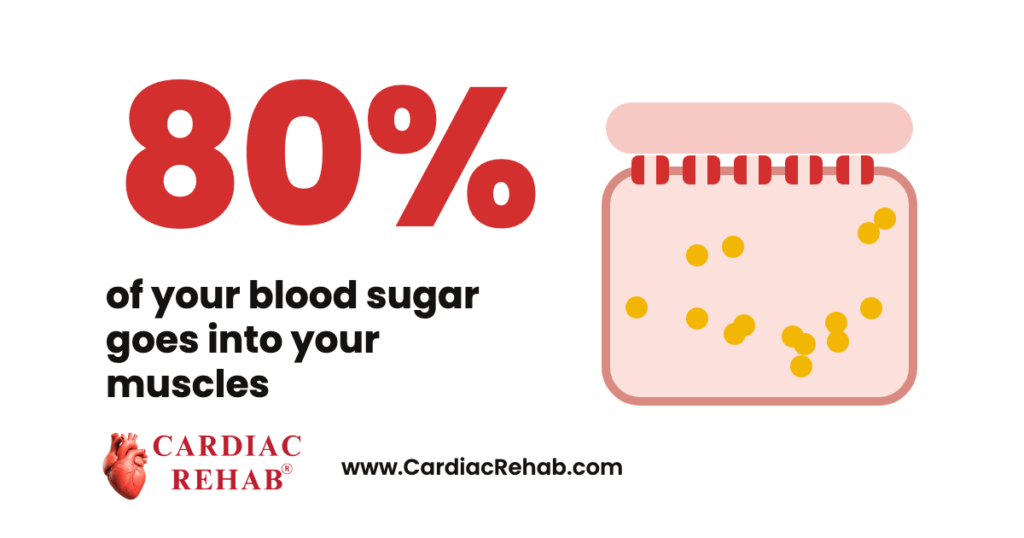
Short answer: Muscles are the biggest sugar user in the body. About 80% of the sugar taken up under insulin goes into skeletal muscle. Exercise opens a second way into muscle that still works in diabetes. Structured exercise lowered HbA1c by 0.67%, and by 0.89% with more than 150 minutes a week (Umpierre, JAMA, 2011). This is how exercise and blood sugar are linked, and why the muscle matters.
In this article
- Diabetes care now looks at the whole person, not only sugar, says BW Healthcare World.
- Skeletal muscle takes up about 80% of the sugar cleared under insulin.
- In diabetes the insulin door is stiff, but exercise opens a second door that still works.
- Training adds more doors, partly through epigenetics: switches on the door gene.
- Structured exercise lowered HbA1c by 0.67%, alongside medicines, never instead of them.
Is diabetes care moving beyond sugar?
On 28 September 2026, BW Healthcare World wrote that diabetes care is no longer only about blood sugar. Doctors now also look at weight, the heart, the kidneys and lifestyle. The article lists new medicines too. Some act on three hormones, some are SGLT2 tablets, and one is a cell therapy for type 1 diabetes.
We welcome all of it. But one organ is missing from the list, and it is the biggest sugar user in the body. It is your muscle. No new medicine can do its job for it.
Where does the sugar in your blood go?
After a meal, sugar enters the blood and insulin tells the body to take it in. Most of it goes to one place. Under insulin, about 80% of the sugar taken up goes into skeletal muscle (DeFronzo and Tripathy, Diabetes Care, 2009). The liver and fat take far less.
In type 2 diabetes, muscle stops answering insulin well. This is called insulin resistance, and it is the first fault in type 2 diabetes (DeFronzo and Tripathy, 2009). So the largest sugar user in the body is also where diabetes begins.
How are exercise and blood sugar linked in the muscle?
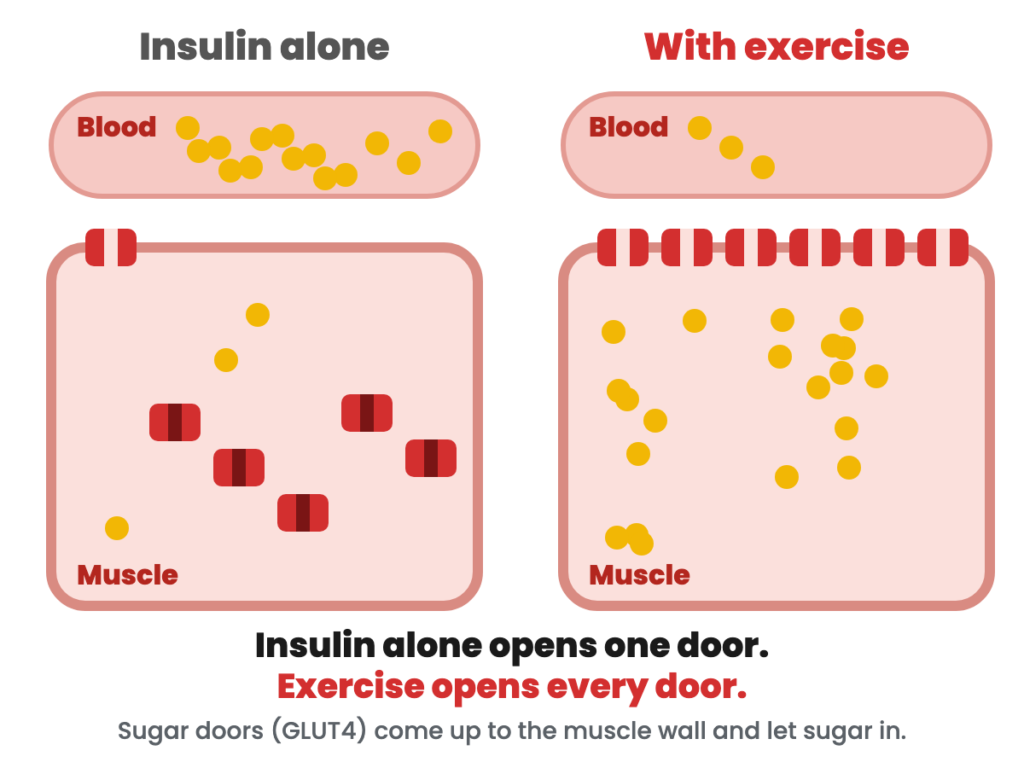
Sugar enters muscle through doors called GLUT4. Insulin is one key that brings these doors to the surface. In diabetes that key works poorly. But muscle has a second key: its own contraction.
In type 2 diabetes, one exercise session still brought the GLUT4 doors to the muscle surface (Kennedy, Diabetes, 1999). The insulin door was stiff, yet the exercise door opened. That is why moving muscles pull sugar out of the blood even when insulin is weak.
Training adds more doors, through epigenetics
Regular training does more than open the doors. It makes the muscle build more of them. Exercise training is the strongest known way to raise GLUT4 in muscle (Richter and Hargreaves, Physiol Rev, 2013). It does this partly by changing the switches on the GLUT4 gene, which is epigenetics. The muscle learns to take in more sugar, day after day.
What does it do to HbA1c?
A review of trials in type 2 diabetes found that structured exercise lowered HbA1c by 0.67% (Umpierre, JAMA, 2011). With more than 150 minutes a week, the fall was 0.89%. Advice to be active, without structured training, did not lower HbA1c on its own.
This is the difference between advice and a programme. Physician supervised, exercise based cardiac rehab is a programme. It sets the workload, watches the heart and the sugar, and raises the effort step by step. It works alongside your medicines, never instead of them.
Always with your medicines. Exercise changes how your sugar behaves. Your doctor may need to adjust your tablets or insulin, which is one more reason to exercise under supervision.
Why cardiac rehab, and not just a walk?
People with diabetes often have a silent heart. As Dr Naresh Trehan told ANI this week, they may feel no chest pain even when the heart is in trouble. Exercise for them should start with a heart check and a physician watching. That is what cardiac rehab is.
Our runners at Telangana Runners show what the muscles can do once the heart is cleared. Most people with diabetes are told to walk, but few are ever given a supervised plan. That gap is why this post exists. Runners can read the same science in our twin post: How running lowers blood sugar.
Your questions, answered
Can exercise lower my blood sugar?
Yes. Structured exercise lowered HbA1c by 0.67% in type 2 diabetes, and by 0.89% with more than 150 minutes a week. Working muscles pull sugar out of the blood through their own doors, even when insulin works poorly. The effect comes from a plan followed week after week, not from advice alone.
Which organ uses most of my blood sugar?
Skeletal muscle. Under insulin, about 80% of the sugar taken up goes into muscle. That is why losing muscle or sitting all day makes diabetes harder to control, and why building muscle fitness helps. In type 2 diabetes, this is also where the trouble starts, because muscle stops answering insulin well.
Does exercise work if my insulin is not working well?
Yes. In type 2 diabetes the insulin route into muscle is weak, but exercise uses a second route. A single session of exercise brought the sugar doors to the muscle surface in people with type 2 diabetes. That is why working muscles can pull sugar out of the blood even when the insulin route is weak.
Can I stop my diabetes medicines if I exercise?
No, not on your own. Exercise works alongside medicines. As your sugar improves, your doctor may reduce a dose, but only your doctor should decide that. Supervised exercise makes those changes safe. Bring your latest HbA1c and your list of medicines when you start, so the plan fits you.
Why should a person with diabetes exercise under supervision?
Diabetes can hide heart disease, because the nerves that signal chest pain may be damaged. A heart check first, and a physician watching during exercise, keeps the effort safe while it lowers sugar. It also lets us watch your sugar during a session, so a low is caught early.
Ask for cardiac rehab
We run cardiac rehab for people with diabetes in Film Nagar, Jubilee Hills, Hyderabad. We check the heart first, then build your muscles’ sugar use step by step. Write to info@cardiacrehab.com, visit www.CardiacRehab.com, or message us on WhatsApp. Bring your latest HbA1c and your list of medicines. Heart attack in your family too? Read how training changes your genes: How cardiac rehab silences the risk genes.
info@cardiacrehab.com · www.CardiacRehab.com
Cardiac Rehab, 7B Journalist Colony, Film Nagar, Jubilee Hills, Hyderabad, Telangana 500096
References
- BW Healthcare World. Diabetes care moves beyond blood sugar control. 28 September 2026. bwhealthcareworld.com/article/diabetes-care-moves-beyond-blood-sugar-control-625815
- DeFronzo RA, Tripathy D. Skeletal muscle insulin resistance is the primary defect in type 2 diabetes. Diabetes Care. 2009. doi.org/10.2337/dc09-S302
- Kennedy JW, et al. Acute exercise induces GLUT4 translocation in skeletal muscle of normal human subjects and subjects with type 2 diabetes. Diabetes. 1999. doi.org/10.2337/diabetes.48.5.1192
- Richter EA, Hargreaves M. Exercise, GLUT4, and skeletal muscle glucose uptake. Physiol Rev. 2013. doi.org/10.1152/physrev.00038.2012
- Umpierre D, et al. Physical activity advice only or structured exercise training and association with HbA1c levels in type 2 diabetes. JAMA. 2011. pubmed.ncbi.nlm.nih.gov/21540423
- ANI. Don’t wait for symptoms; get your heart checkup done before 25 yrs of age, says Medanta Group Chairman Dr Trehan. 28 September 2026. aninews.in/news/national/general-news/dont-wait-for-symptoms-get-your-heart-checkup-done-before-25-yrs-of-age-says-medanta-group-chairman-dr-trehan16020260928214532