
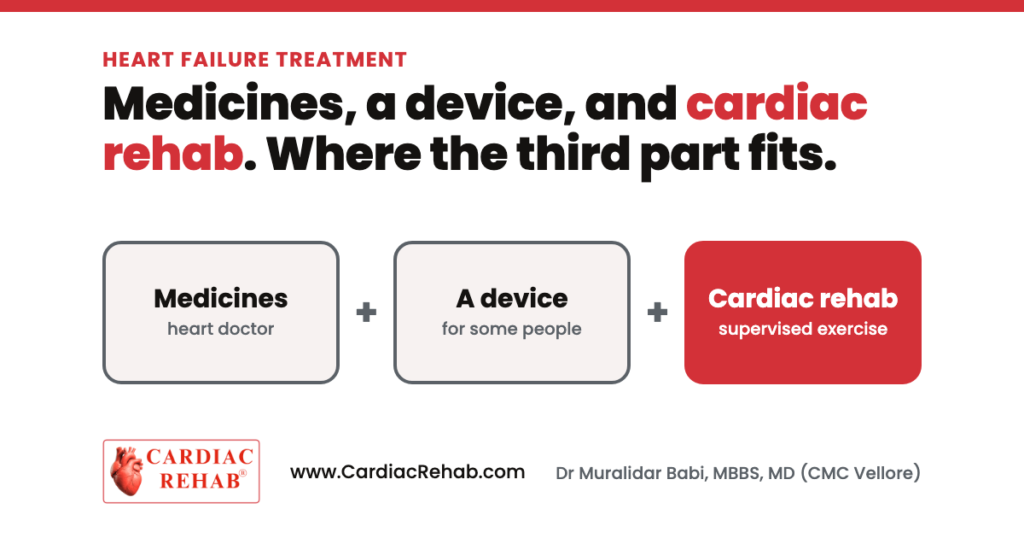
Short answer: Cardiac rehab for heart failure is one part of treatment, beside medicines and, for some people, a device. In 60 trials, people who did exercise based cardiac rehab went to hospital less. About 16 in 100 were admitted in the first year, against 24 in 100. Your heart doctor keeps the medicines. We run the exercise part, under physician supervision.
In this article
- In an Indian registry, 83 in 100 people admitted with heart failure died within 10 years.
- The NHS says everyone diagnosed with heart failure should be offered cardiac rehab.
- Exercise based cardiac rehab cut hospital stays in 60 trials: about 16 in 100 against 24 in 100 in a year.
- In 18 trials, steady exercise raised EF by about 4 points; 6-month programmes by about 6.
- Exercise does not make heart failure go away. It sits beside medicines, never instead of them.
What heart failure does, and what it costs in India
Heart failure means the heart cannot pump blood as well as it should. It does not mean the heart has stopped, or is about to stop. The NHS lists the signs: breathless with everyday tasks or lying flat, tired and weak, swollen feet and legs, and sudden weight gain. No treatment makes it go away yet, but treatment and daily habits can keep it stable for many years.
The cost in India is high. The Trivandrum Heart Failure Registry followed 1,205 people admitted to 18 hospitals in Kerala in 2013. Over the next 10 years, 83 in 100 of those followed up had died, and 96 in 100 of those deaths were from the heart. Heart artery disease was the cause of the heart failure in 72 in 100 of them.
The same registry found a treatment gap. At discharge, only 25 in 100 people with a weak pump got the three guideline medicines together. Those who did had fewer deaths over 10 years: 76 in 100 against 89 in 100. The medicines matter, and so does what comes next: the exercise part of care.
Why keeping active helps a weak heart
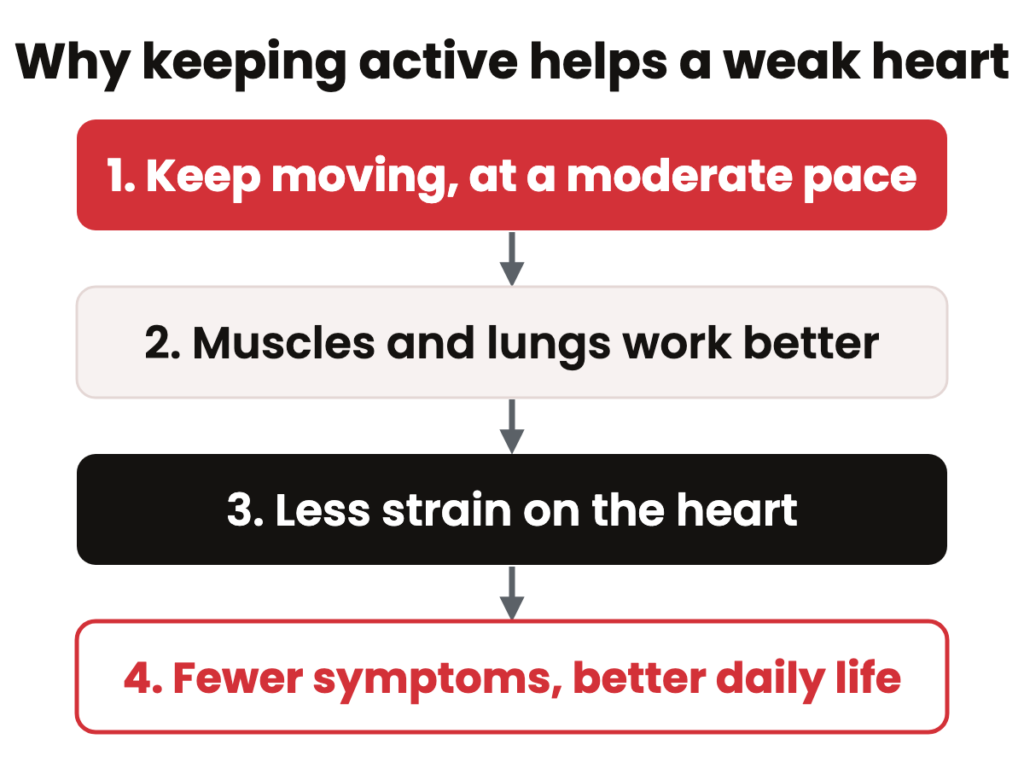
Heart failure can leave you breathless and tired, even exhausted. So making yourself a little more breathless on purpose can feel scary. The British Heart Foundation puts it plainly: in the past, people with heart failure were told they needed rest. We now know that keeping active can improve symptoms and daily life.
Muscles and lungs do more of the work
When you keep your body moving, your muscles and lungs work better. That puts less strain on the heart, because the same walk now costs the heart less effort. Exercise can also lift your mood and your energy. Even people who are bothered a lot by their symptoms may see small gains once they exercise regularly.
What exercise does not do
The BHF is clear on one thing. Staying active lowers the risk of getting heart failure, but once you have it, exercise does not make it go away and does not reverse it. What it does is improve how you feel and what you can do. Research also links exercise in heart failure with a lower risk of being hospitalised.
What cardiac rehab for heart failure does
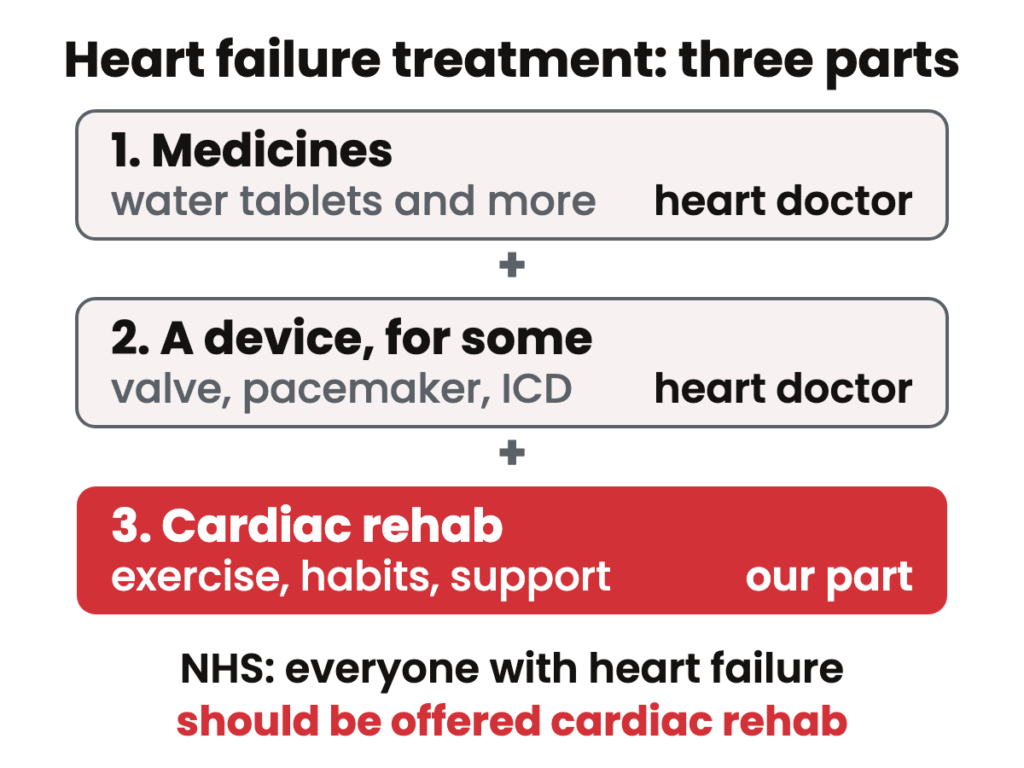
The NHS guide lists heart failure treatment in three parts: medicines, surgery or a device for some people, and cardiac rehab. It says everyone diagnosed with heart failure should be offered cardiac rehab. Your heart doctor leads the first two parts. Physician supervised, exercise based cardiac rehab is the third, and it sits beside the other two, never instead of them.
A check first, then a plan made for you
The NHS says cardiac rehab starts with an assessment and advice on how to exercise safely. Then comes exercise, as classes or a personal programme. At Cardiac Rehab in Hyderabad, a doctor sees you first and reads your echo report and medicine list. Your exercise plan is then built for your heart, not copied from a chart.
Exercise under physician supervision
Our programme runs for 6 months: 90 minutes, 3 times a week, on Monday, Wednesday and Friday. Your 12-lead ECG trace is watched while you exercise, under physician supervision. So you learn your safe level instead of guessing at home. Step by step, the work gets harder as you get stronger.
Daily habits and support
The NHS lists two more parts of cardiac rehab: guidance on daily habits such as healthy eating, and a group where you can share what you are going through with others who have heart failure. Weighing yourself often matters too, because sudden weight gain can mean water is building up. Our answer page on cardiac rehab for heart failure covers the safety rules in plain words. For the EF number itself, read how to increase heart pumping.
The evidence: what the trials found
The largest trial is HF-ACTION, published in JAMA in 2009. It followed 2,331 people with heart failure and a weak pump, at 82 centres, for a median of 30 months. Half got usual care plus 36 supervised exercise sessions, then home exercise. Deaths or hospital stays were 65 in 100 with exercise against 68 in 100 without, a small difference that was not significant in the main analysis. After adjusting for how ill people were at the start, the gain was significant, and other adverse events were similar in both groups.
A Cochrane review in 2024 pooled 60 trials with 8,728 people. In the first year, about 16 in 100 who did exercise based cardiac rehab were admitted to hospital, against about 24 in 100 who did not. Quality of life was likely better, by about 7 points on the Minnesota heart failure scale, where 5 points is a meaningful change. The review found no difference in deaths within a year.
Can the pump itself get stronger? In 2019, Tucker and colleagues pooled 18 trials of people with a low EF. Steady aerobic exercise raised EF by about 4 points on average, and programmes of 6 months or more raised it by about 6 points. Shorter programmes gave about 2 points, and weight training alone did not change EF. No one can promise how much your EF will rise.
Heart guidelines agree. For stable heart failure, the US guidelines (AHA and ACC) and the European guidelines (ESC) give exercise training their highest grade, Class I, Level A. That is the same grade they give cardiac rehab after a heart attack, a stent or a bypass. Read our health insurance post for how a claim can work after a hospital stay.
Who it is for, and when to start
Exercise based cardiac rehab is for stable heart failure. The BHF says to speak to your doctor first, and that you may need to start under supervision in a cardiac rehab class. In HF-ACTION, the people who exercised had a median EF of 25 percent, and 37 in 100 had marked symptoms. A low number on its own does not rule you out, but your heart doctor decides when you are stable.
Some signs mean stop and tell your doctor. The BHF lists palpitations, extreme shortness of breath, and light-headedness during exercise. Do not exercise on days you are unwell, or more tired or breathless than normal. The NHS adds urgent signs for any day: breathless lying down, coughing up frothy pink phlegm, or sudden weight gain.
Moderate is the word to remember. You feel warmer and breathe a bit harder, but you can still talk. Warm up, cool down, and do not lie down straight after exercise. Avoid heavy weights, holding your breath, and press-ups or planks. Little and often works: a few 5 to 10 minute walks a day add up.
Your questions, answered
Can exercise make heart failure go away?
No. The BHF says heart failure does not go away, and exercise does not reverse it. What exercise does is ease symptoms, improve daily life and lower the chance of a hospital stay. In 60 trials, about 16 in 100 who exercised were admitted in a year, against 24 in 100 who did not. Medicines and, for some, a device remain the base of treatment.
Is cardiac rehab safe with an EF of 25 to 30 percent?
It can be, when your heart doctor says you are stable and the exercise is supervised. In the HF-ACTION trial, the median EF was 25 percent, and other adverse events were similar with and without exercise. The programme starts with a check, and the first sessions are gentle. Your ECG trace is watched while you exercise.
Will my ejection fraction go up?
It may. In 18 trials, steady aerobic exercise raised EF by about 4 points on average. Programmes of 6 months or more raised it by about 6 points, and shorter ones by about 2. Some people gain more, some less, and some not at all. No one can promise a number, and a better EF is a bonus, not the goal.
Can I just exercise at home instead?
Some people can, later. The 2024 Cochrane review found the benefit was similar whether cardiac rehab was centre-based or home-based. But the BHF says to speak to your doctor first, and that you may need to start under supervision. A supervised start teaches you your safe level, which you then carry home.
Does cardiac rehab replace my heart failure medicines?
No. Medicines stay with your heart doctor, and so does any device such as a pacemaker or an ICD. The Indian registry showed why: people on the three guideline medicines had fewer deaths over 10 years, 76 in 100 against 89 in 100. Cardiac rehab is the third part of treatment, beside the other two.
How soon after a hospital stay can I start?
When your heart doctor says you are stable. The NHS says cardiac rehab begins with an assessment and advice on safe exercise, and that is how our programme starts. Bring your discharge papers, your echo report and your medicine list to the first visit. Insurance claims for care after a hospital stay usually run for 60 to 180 days.
Cardiac rehab for heart failure in Hyderabad
Cardiac Rehab runs physician supervised, exercise based cardiac rehab at 7B Journalist Colony, Film Nagar, Jubilee Hills, Hyderabad. It is for people with heart failure, and after a heart attack, a stent or a bypass. A doctor checks you first, and a first visit can be booked online. Write to info@cardiacrehab.com, visit www.CardiacRehab.com, or message us on WhatsApp. Many people later keep moving with Telangana Runners, our running community.
info@cardiacrehab.com · www.CardiacRehab.com
Cardiac Rehab, 7B Journalist Colony, Film Nagar, Jubilee Hills, Hyderabad, Telangana 500096
References
- NHS. Heart failure: symptoms, causes, treatments and living with it. Reviewed 26 June 2026. nhs.uk/conditions/heart-failure
- Farthing G. Exercise for heart failure: tips for exercising safely. British Heart Foundation, Heart Matters. Updated 27 January 2026. bhf.org.uk/informationsupport/heart-matters-magazine/activity/exercise-for-heart-failure
- Molloy C, et al. Exercise-based cardiac rehabilitation for adults with heart failure. Cochrane Database of Systematic Reviews. 2024. doi.org/10.1002/14651858.CD003331.pub6
- O’Connor CM, et al. Efficacy and safety of exercise training in patients with chronic heart failure: HF-ACTION randomized controlled trial. JAMA. 2009. doi.org/10.1001/jama.2009.454
- Tucker WJ, et al. Meta-analysis of exercise training on left ventricular ejection fraction in heart failure with reduced ejection fraction: a 10-year update. Progress in Cardiovascular Diseases. 2019. doi.org/10.1016/j.pcad.2018.08.006
- Long-term prognosis in heart failure: findings from the ten-year follow-up of the Trivandrum Registry. Journal of Cardiac Failure. 2026. doi.org/10.1016/j.cardfail.2026.07.028
- Taylor RS, et al. The role of cardiac rehabilitation in improving cardiovascular outcomes. Nature Reviews Cardiology. 2022. ncbi.nlm.nih.gov/pmc/articles/PMC8445013