Short answer: Yes, you can change a family story. A family history of heart attack doubles your risk, but your genes are not your fate. Physician supervised, exercise based cardiac rehab changes the switches on your genes. This is called epigenetics. People with high family risk who lived well had 46% lower risk of heart events (Khera, NEJM, 2016).
In this article
- A parent or grandparent with heart disease doubles your risk, says Dr Naresh Trehan.
- Epigenetics is the science of the switches on your genes. Your DNA stays the same; the switches change.
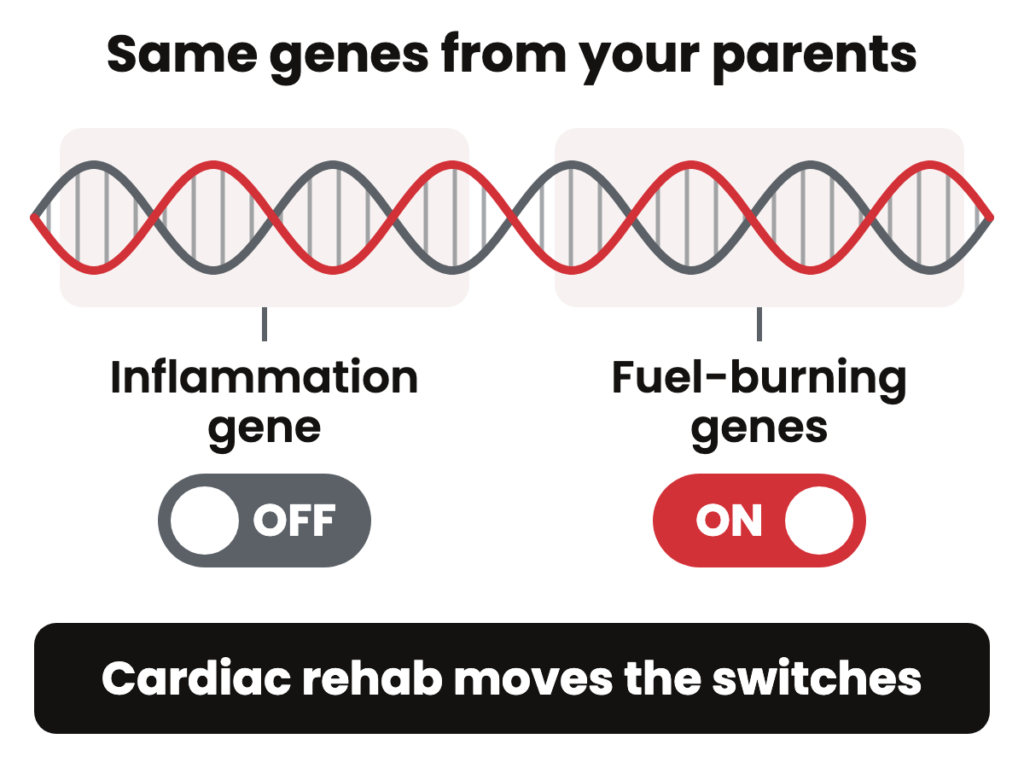
- Exercise quietens an inflammation gene and switches on genes that help muscles burn fuel.
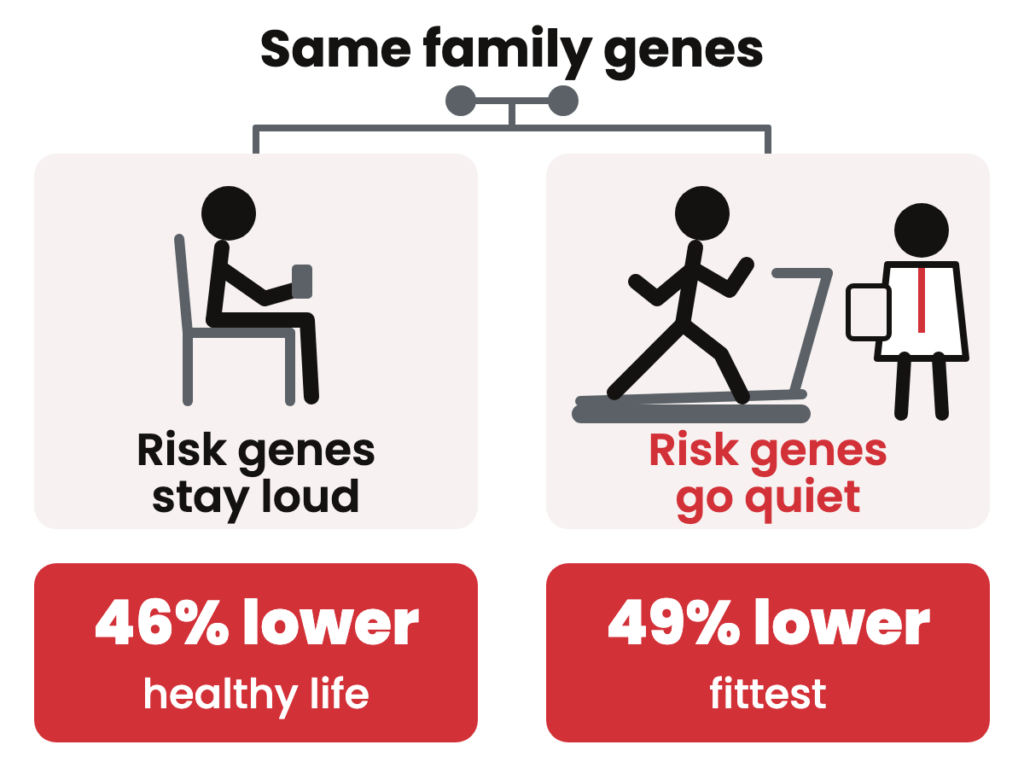
- High family risk plus a healthy life meant 46% lower risk; high fitness meant 49% lower risk.
- Cardiac rehab gives you that fitness safely, with a physician watching every step.
What did Dr Trehan say?
On 28 September 2026, Dr Naresh Trehan of Medanta spoke to ANI about young people having heart attacks. He said that if a parent, an uncle or a grandparent had heart disease, your chance of getting it is double. He advised a first heart check before the age of 25. He also warned that people with diabetes may feel no chest pain at all.
We agree with every word. An early check tells you where you stand. But a check is only the first step. The question every family asks next is simple: now that I know, what do I do?
Are heart attack genes a life sentence?
No. The genes you get from your parents are fixed, but how loudly each gene speaks is not. Every gene has chemical switches sitting on it. These switches decide whether the gene is read often, rarely or not at all.
The science of these switches is called epigenetics. The word means “on top of the genes”. Your DNA letters stay the same all your life, but the marks on top of them move. Food, smoking, sleep and above all exercise move them.
Epigenetics, in one line: your genes are the piano keys; epigenetics decides which keys get played.
How does cardiac rehab change the switches?
Cardiac rehab is exercise under a physician’s eye. The physician raises the workload a little at a time, while heart rate, blood pressure and symptoms are watched. Every session sends the same signal to your cells, again and again, for weeks.
It silences a harmful gene
Long-lasting inflammation hurts the lining of the arteries. In one study, older adults did brisk and easy walking for six months. Their inflammation gene, called ASC, kept more switch marks (Nakajima, Int J Sports Med, 2010). More marks mean the gene is read less. In plain words, the inflammation gene went quieter.
It switches on helpful genes
A single exercise session took switch marks off genes that help muscles burn fuel. Those genes then turned on (Barrès, Cell Metabolism, 2012). Six months of exercise changed the switches on 7,663 genes in body fat (Rönn, PLoS Genetics, 2013). The body reads its genes differently after training.
Does it really lower the risk for families like mine?
Yes, and the numbers are large. A study of 55,685 people looked at those with the highest genetic risk of heart disease. Those with a healthy lifestyle had a 46% lower risk of heart events than those without one (Khera, NEJM, 2016). A healthy lifestyle there meant no smoking, no obesity, regular exercise and a healthy diet.
Fitness alone told the same story. The UK Biobank study followed 502,635 people. Among those with high genetic risk, the fittest had 49% lower risk of heart disease than the least fit (Tikkanen, Circulation, 2018). Cardiac rehab builds exactly this fitness. Across 85 trials and 23,430 people, it lowered heart attacks, with a relative risk of 0.72 (Dibben, Cochrane, 2021).
Who should think about cardiac rehab?
Anyone whose parent, sibling or grandparent had heart disease young should get checked early, as Dr Trehan says. If the check finds risk factors, supervised exercise is one of the strongest tools we have. It also suits anyone after a heart attack, angioplasty, bypass surgery or with heart failure. Yet most people who could benefit are never told about it.
Living differently from your parents is what makes the difference. If your fitness and your food are very different from theirs, your genes hear a different message. Our sister community, Telangana Runners, shows every week that ordinary people can build that fitness together. Their everyday version of this story, for runners and walkers, is on the Telangana Runners blog.
Your questions, answered
Can exercise change my genes?
No, it does not change the DNA letters. It changes the switches on top of them, which is called epigenetics. In studies, exercise quietened an inflammation gene and switched on genes that help muscles burn fuel. So the same genes are read differently after training.
My father had a heart attack at 45. Am I next?
Not necessarily. Your risk is higher, about double according to Dr Naresh Trehan. But people with the highest genetic risk who lived a healthy life had 46% lower risk of heart events. Get checked early, and start supervised exercise before the problem starts.
What is epigenetics in simple words?
Epigenetics is the science of the switches on your genes. Your genes are like piano keys, and epigenetics decides which keys get played. Food, smoking, sleep and exercise move these switches. That is why two people with the same genes can have very different hearts.
Is cardiac rehab only for people who already had a heart attack?
No. Cardiac rehab is also a primary prevention programme, to prevent a first heart attack. People with a strong family history, diabetes or high blood pressure can start it. The physician sets the exercise to your own heart and raises it safely.
How long before the switches change?
A single exercise session already changed switch marks on muscle genes in one study. Six months of exercise changed switches on thousands of genes. The benefit lasts only while the exercise lasts, so cardiac rehab builds a habit, not a short course.
Ask for cardiac rehab
Physician supervised, exercise based cardiac rehab runs at our clinic in Film Nagar, Jubilee Hills, Hyderabad. It suits people with a strong family history, and people after a heart attack, angioplasty or bypass. Write to info@cardiacrehab.com, visit www.CardiacRehab.com, or message us on WhatsApp. We will check your risk and set a plan that starts where you are. Each session trains the lungs as well as the heart, as our World Lung Day post explains: Can exercise make your lungs work better for your heart?
info@cardiacrehab.com · www.CardiacRehab.com
Cardiac Rehab, 7B Journalist Colony, Film Nagar, Jubilee Hills, Hyderabad, Telangana 500096
References
- ANI. Don’t wait for symptoms; get your heart checkup done before 25 yrs of age, says Medanta Group Chairman Dr Trehan. 28 September 2026. aninews.in/news/national/general-news/dont-wait-for-symptoms-get-your-heart-checkup-done-before-25-yrs-of-age-says-medanta-group-chairman-dr-trehan16020260928214532
- Khera AV, et al. Genetic risk, adherence to a healthy lifestyle, and coronary disease. N Engl J Med. 2016. doi.org/10.1056/NEJMoa1605086
- Tikkanen E, Gustafsson S, Ingelsson E. Associations of fitness, physical activity, strength, and genetic risk with cardiovascular disease. Circulation. 2018. doi.org/10.1161/CIRCULATIONAHA.117.032432
- Nakajima K, et al. Exercise effects on methylation of ASC gene. Int J Sports Med. 2010. doi.org/10.1055/s-0029-1246140
- Barrès R, et al. Acute exercise remodels promoter methylation in human skeletal muscle. Cell Metab. 2012. pubmed.ncbi.nlm.nih.gov/22405075
- Rönn T, et al. A six months exercise intervention influences the genome-wide DNA methylation pattern in human adipose tissue. PLoS Genet. 2013. doi.org/10.1371/journal.pgen.1003572
- Dibben G, et al. Exercise-based cardiac rehabilitation for coronary heart disease. Cochrane Database Syst Rev. 2021. doi.org/10.1002/14651858.CD001800.pub4