

Short answer: Running injury is common: about 1 in 3 runners got hurt in 18 months. In a study of 5,205 runners, the danger was one run much longer than their longest run of the last 30 days. Keep each run within 10% of that number.
In this article
- 1,820 of 5,205 runners, about 1 in 3, got a running injury in 18 months.
- A run 10-30% longer than your longest of the last 30 days was linked to 64% more injuries.
- A run more than double your longest: 2.3 times the injury rate.
- The week-to-week change did not show the same link; the single long run did.
- New runners get about 18 injuries per 1,000 hours; regular runners about 8.
How common is running injury?
In a study that followed 5,205 runners for 18 months, each runner wore a Garmin watch, so every run was counted. During those 18 months, 1,820 of them reported a running injury. That is about 1 in 3. Most were overuse injuries, the kind that build up from load rather than a fall.
New runners get hurt more often. When 13 studies were pooled, new runners had about 18 injuries for every 1,000 hours of running. Regular runners had about 8. So the first months of running are the time to be most careful.
The one long run that raises the risk
The same Garmin study compared every run with the runner’s longest run of the last 30 days. Runs up to 10% longer than that were the normal rate. A run 10 to 30% longer was linked to 64% more overuse injuries. A run 30% longer up to double: 52% more. A run more than double: 2.3 times the rate.
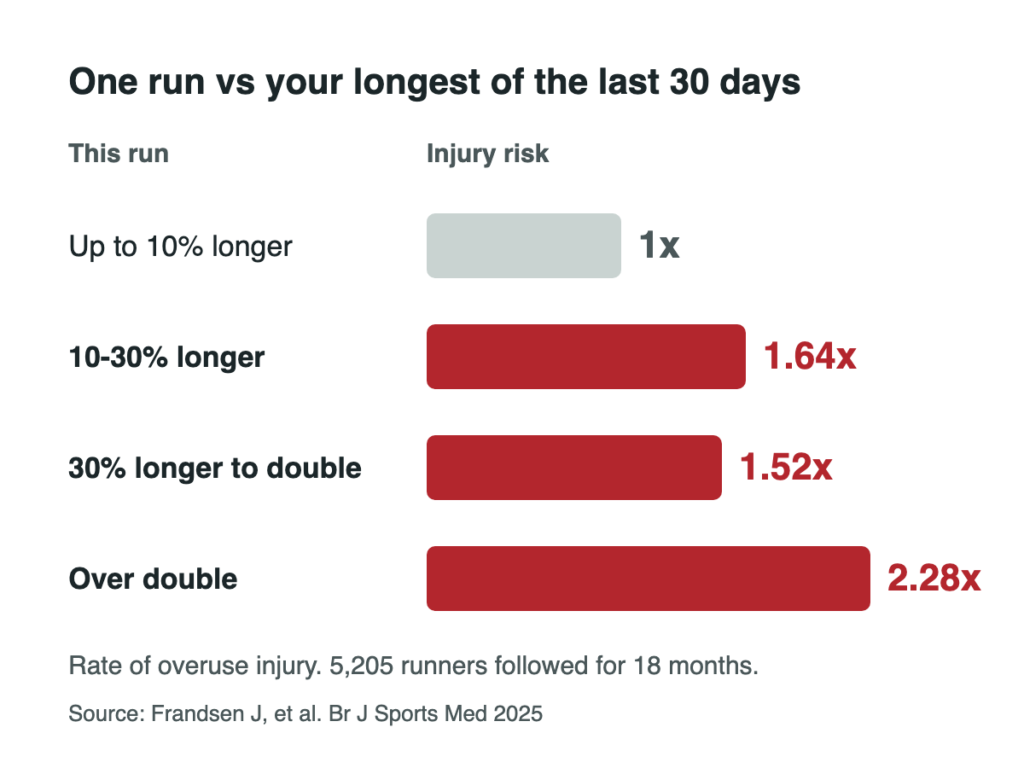
Any jump over 10% raised the risk. The middle group was a little lower than the 10 to 30% group, so this is not a straight line. But the message is the same: one run far past your usual longest run is the danger.
Why it happens
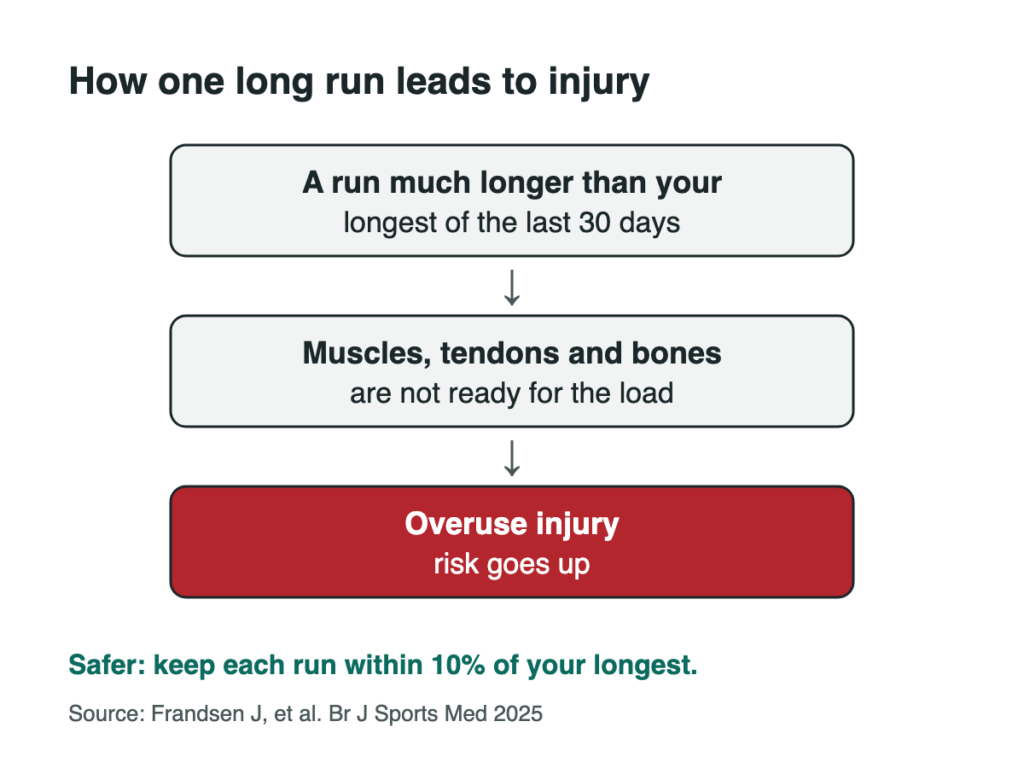
Muscles, tendons and bones get stronger when you load them, but they need time to catch up. The Garmin study names the problem plainly: running too much before your body’s tissues can take the load. One sudden long run asks for more than they are ready to give.
Not the weekly total
Many runners follow the 10% weekly rule. In the Garmin study, the change from one week to the next did not show the same link with injury. It was the single long run that did.
A trial in 532 new runners tested a slow 13-week plan built on adding 10% a week against a normal 8-week plan. About 1 in 5 got hurt on both plans: 20.8% and 20.3%. In an earlier study of new runners, a weekly jump of more than 30% over 2 weeks was linked to more injuries of the type that comes from distance, though that result was not certain.
A safe way to go longer
Know your number: your longest run of the last 30 days. Keep your next run within 10% of it. If your longest run was 10 km, your next long run should be up to about 11 km. Do not copy a friend’s long run. Their number is not yours.
If you have heart disease, diabetes or high blood pressure, or you are starting again after a long break, start with your doctor. A physician supervised exercise intervention sets the safe pace and builds the load step by step. Physician supervised, exercise based cardiac rehab works the same way: small, planned steps up. The runner’s side of this story is on the Telangana Runners blog: why runners get injured.
Your questions, answered
Why do runners get injured so often?
Often it is one run that is too long. In 5,205 runners, a run 10 to 30% longer than their longest of the last 30 days was linked to 64% more overuse injuries (Frandsen 2025). Muscles, tendons and bones need time to get ready for a new load.
Is the 10% weekly rule enough?
Not on its own. In the Garmin study, the week-to-week change did not show the same link with injury, while the single long run did (Frandsen 2025). A trial of a slow 10% plan in new runners found about the same injuries as a normal plan (Buist 2008).
How much longer can my next long run be?
Keep it within about 10% of your longest run of the last 30 days. Runs up to 10% longer were the normal injury rate in the study (Frandsen 2025). If your longest was 10 km, plan up to about 11 km next.
Are new runners at more risk?
Yes. Pooled studies found about 18 injuries per 1,000 hours of running in new runners and about 8 in regular runners (Videbaek 2015). Build up slowly in the first months, and see your doctor first if you have a heart condition.
Build the load safely, with your doctor
A physician supervised exercise intervention sets the safe pace and adds load step by step. General advice: your own doctor knows your health.
info@cardiacrehab.com · www.CardiacRehab.com
Cardiac Rehab, 7B Journalist Colony, Film Nagar, Jubilee Hills, Hyderabad, Telangana 500096
References
- Frandsen JSB, Hulme A, Parner ET, et al. How much running is too much? Identifying high-risk running sessions in a 5200-person cohort study. Br J Sports Med. 2025. pubmed.ncbi.nlm.nih.gov/40623829
- Videbaek S, Bueno AM, Nielsen RO, Rasmussen S. Incidence of running-related injuries per 1000 h of running in different types of runners: a systematic review and meta-analysis. Sports Med. 2015. pubmed.ncbi.nlm.nih.gov/25951917
- Buist I, Bredeweg SW, van Mechelen W, et al. No effect of a graded training program on the number of running-related injuries in novice runners: a randomized controlled trial. Am J Sports Med. 2008. pubmed.ncbi.nlm.nih.gov/17940147
- Nielsen RO, Parner ET, Nohr EA, et al. Excessive progression in weekly running distance and risk of running-related injuries: an association which varies according to type of injury. J Orthop Sports Phys Ther. 2014. pubmed.ncbi.nlm.nih.gov/25155475