
Short answer: Heart pounding, chest tight, and a feeling you are about to die. It feels like a heart attack, but often it is a panic attack. This article explains the vagus nerve, the heart’s calm-down brake, and how cardiac rehab makes it stronger.
In this article
- About 1 in 8 people have a panic attack in their life, and most have more than one.
- A panic attack copies a heart attack, so families rush to hospital again and again.
- The vagus nerve is the heart’s calm-down brake, and anxious bodies have a weaker one.
- Cardiac rehab trains the brake and brings on a fast heart safely, with a doctor watching.
What does a panic attack feel like?
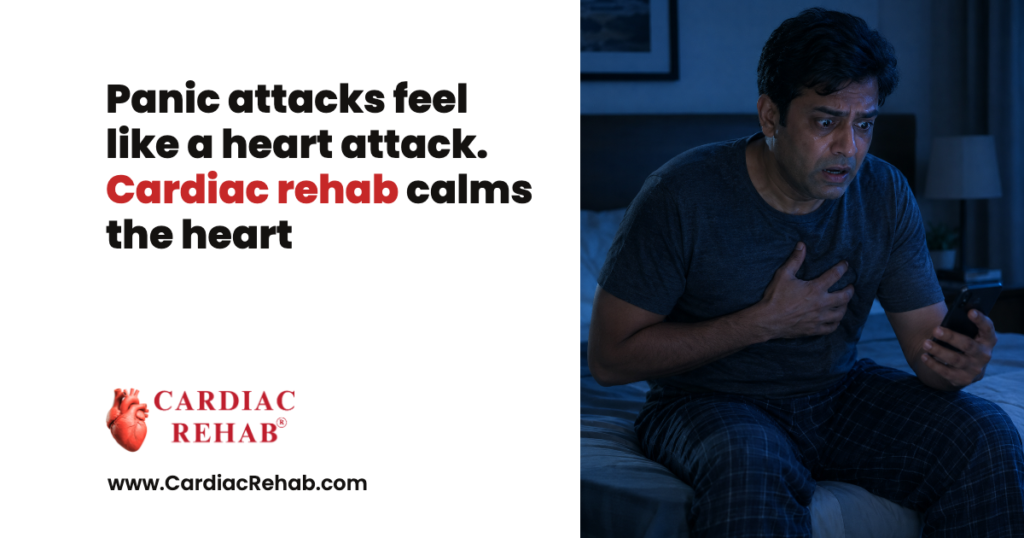
Out of nowhere, the heart starts to race. The chest feels tight and the breath goes short. The hands shake and the skin goes cold. Then comes a wave of doom, a strong feeling that something terrible is happening and this is the end.
Many people are sure it is a heart attack. That is not foolish, because a panic attack copies the feelings of a heart attack very closely. When the attack passes, a new fear stays behind: the fear of the next one. People start to watch every heartbeat, and that watching makes the next attack more likely.
Why do families keep rushing to hospital?
In a survey of 142,949 people in 25 countries, 13.2% had a panic attack at some point in their life. Two in three of them had more than one. You are not alone, and you are not imagining it.
Because the feelings copy a heart attack, people go to the emergency room. In one hospital in Italy, 361 of 469 people with panic attacks came back more than once. In many homes someone drives to hospital at midnight, someone misses work, and the bills grow. The tests come back normal, but nothing found does not end the fear for anyone in the house.
Chest pain and a racing heart must always be checked by a doctor first. A heart attack and a rhythm problem must be ruled out. Once the heart is checked and clear, the fear itself can be treated. That is where the rest of this article starts.
Meet your vagus nerve
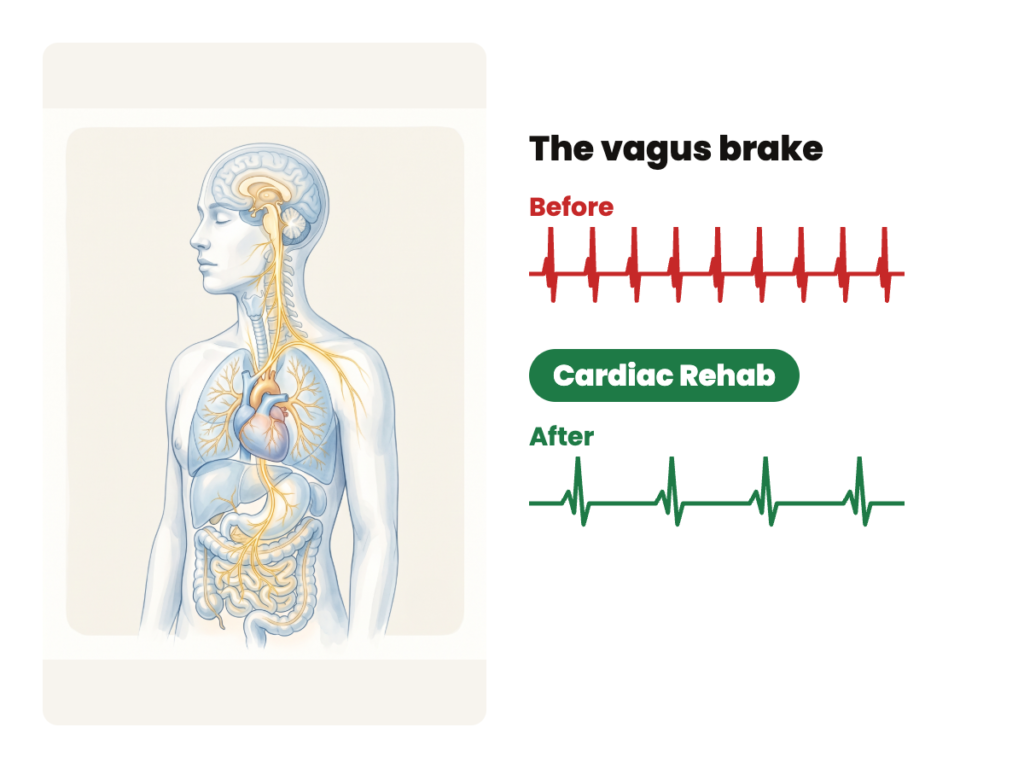
The vagus nerve is the main nerve of the body’s rest and digest side. It runs from the brain down to the heart, the lungs and the gut. It helps control mood, the immune system, digestion and the heart rate. A review in Frontiers in Psychiatry (2018) found that the stronger its tone, the better a person handles stress.
Think of the vagus nerve as the heart’s calm-down brake. Every few seconds it slows the heart a little, which is why a healthy heart beat is never perfectly even. A review of many studies found that people with anxiety disorders, including panic disorder, have a weaker brake. It shows up as less beat-to-beat change in the heart rate.
How does cardiac rehab calm the heart?
Exercise training is a slow change. A review in PLoS One (2024) looked at heart patients. Physical activity improved the beat-to-beat change in their heart, the sign of a stronger brake. In runners, the slow resting heart comes mainly from this nerve brake. Across 191 studies, endurance training and yoga lowered the resting heart rate.
The heart then sits lower and steadier at rest. So there is less of the racing beat that people feel and fear. These studies measured a lower resting heart rate. They did not count fewer panic attacks, so slower and steadier is the honest claim.
There is a second reason it helps. A fast heart and short breath are the very feelings that start the panic. In cardiac rehab, the heart beats fast on purpose, with a doctor watching, and you come back fine. In a trial of 60 people, exercise sharply cut the fear of these body feelings.
A stronger vagus does more than calm the heart. It is linked to how well we handle stress, and breathing, yoga and meditation raise it. Treatments that boost the vagus also lower the body’s inflammation signals.
It also connects the brain and the gut. A review of 11 studies looked at 392 people with bowel trouble. Those whose trouble caused constipation had the weakest vagal tone. In 9 trials of 680 people, exercise improved constipation, though the trials were not strong.
What does the proof show?
In people with panic disorder, 10 weeks of running reduced symptoms more than a dummy pill. A medicine worked faster and more strongly, so exercise sits beside treatment, not in place of it. Across 1,039 trials and 128,119 people, being active lowered anxiety.
This is the change we work for. From fearing every heartbeat, to walking, then running, then playing sport. The heart is the same, and the fear is gone. For stress that keeps you awake at night, read Stress, sleepless nights and the heart.
Your questions, answered
Can a panic attack feel like a heart attack?
Yes. A racing heart, a tight chest, short breath and a feeling of doom are common in both. That is why chest pain must always be checked by a doctor first. Once the heart is clear, the panic itself can be treated.
Is it safe to exercise if my heart races?
Get checked first. In cardiac rehab the heart is watched while you exercise, and the effort rises step by step. A fast heart during exercise is normal and expected. Learning that it is safe is part of the treatment. In a trial of 60 people, exercise sharply cut the fear of these body feelings.
What is the vagus nerve?
It is the main nerve of the body’s rest and digest side. It runs from the brain to the heart, lungs and gut. It slows the heart and helps control mood, digestion and inflammation. The stronger its tone, the better a person handles stress, and regular exercise helps build it.
Will exercise stop my panic attacks?
Exercise lowers anxiety and the fear of body feelings, and it makes the resting heart slower and steadier. It is not a promise that attacks will never come. It works best alongside treatment from your doctor. Across 1,039 trials and 128,119 people, being active lowered anxiety.
Does cardiac rehab replace my medicines?
No. Keep taking what your doctor prescribed. Cardiac rehab adds supervised exercise, step by step, with your heart watched. In the running trial, a medicine worked faster than exercise, so the two sit side by side. Any change in medicines is your doctor’s decision, never a decision to make alone.
Living with panic and palpitations? Join Cardiac Rehab
Physician supervised, exercise based cardiac rehab. We check your heart, then build your exercise step by step with your heart watched. Join Cardiac Rehab at www.CardiacRehab.com. For runners and walkers, the same story is told on the Telangana Runners blog.
info@cardiacrehab.com · www.CardiacRehab.com
Cardiac Rehab, 7B Journalist Colony, Film Nagar, Jubilee Hills, Hyderabad, Telangana 500096
References
- de Jonge P, et al. Cross-national epidemiology of panic disorder and panic attacks in the world mental health surveys. Depress Anxiety. 2016;33:1155-1177. pubmed.ncbi.nlm.nih.gov/27775828
- Buccelletti F, et al. Recurrent use of the Emergency Department in patients with anxiety disorder. Eur Rev Med Pharmacol Sci. 2013;17 Suppl 1:100-6. pubmed.ncbi.nlm.nih.gov/23436671
- Breit S, et al. Vagus nerve as modulator of the brain-gut axis in psychiatric and inflammatory disorders. Front Psychiatry. 2018;9:44. pubmed.ncbi.nlm.nih.gov/29593576
- Chalmers JA, et al. Anxiety disorders are associated with reduced heart rate variability: a meta-analysis. Front Psychiatry. 2014;5:80. pubmed.ncbi.nlm.nih.gov/25071612
- El-Malahi O, et al. Beneficial impacts of physical activity on heart rate variability: a systematic review and meta-analysis. PLoS One. 2024;19:e0299793. pubmed.ncbi.nlm.nih.gov/38578755
- Reimers AK, et al. Effects of exercise on the resting heart rate: a systematic review and meta-analysis of interventional studies. J Clin Med. 2018;7:503. pubmed.ncbi.nlm.nih.gov/30513777
- Azevedo LF, et al. Sport modality affects bradycardia level and its mechanisms of control in professional athletes. Int J Sports Med. 2014;35:954-9. pubmed.ncbi.nlm.nih.gov/24886917
- Smits JA, et al. Reducing anxiety sensitivity with exercise. Depress Anxiety. 2008;25:689-699. pubmed.ncbi.nlm.nih.gov/18729145
- Broocks A, et al. Comparison of aerobic exercise, clomipramine, and placebo in the treatment of panic disorder. Am J Psychiatry. 1998;155:603-609. pubmed.ncbi.nlm.nih.gov/9585709
- Singh B, et al. Effectiveness of physical activity interventions for improving depression, anxiety and distress: an overview of systematic reviews. Br J Sports Med. 2023;57:1203-1209. pubmed.ncbi.nlm.nih.gov/36796860
- Liu Q, et al. Autonomic functioning in irritable bowel syndrome measured by heart rate variability: a meta-analysis. J Dig Dis. 2013;14:638-46. pubmed.ncbi.nlm.nih.gov/23927739
- Gao R, et al. Exercise therapy in patients with constipation: a systematic review and meta-analysis of randomized controlled trials. Scand J Gastroenterol. 2019;54:169-177. pubmed.ncbi.nlm.nih.gov/30843436