
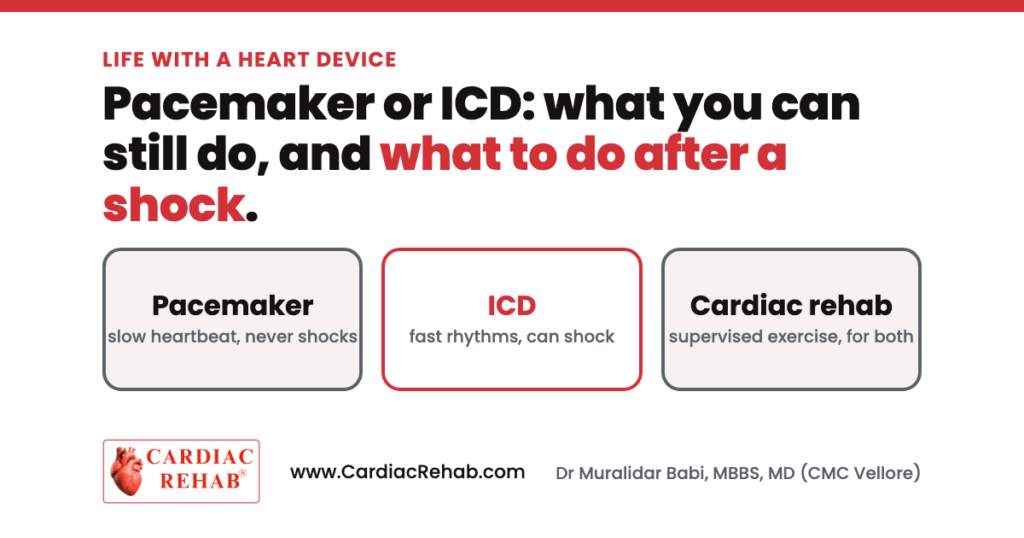
Short answer: Life with a pacemaker or an ICD comes with one question: what can I still do? For most people, the answer is nearly everything. A pacemaker keeps a slow heart going. An ICD watches for dangerous fast rhythms and can give a shock. Here are the first six weeks and the everyday rules. Then what to do after a shock, and where physician supervised cardiac rehab fits.
In this article
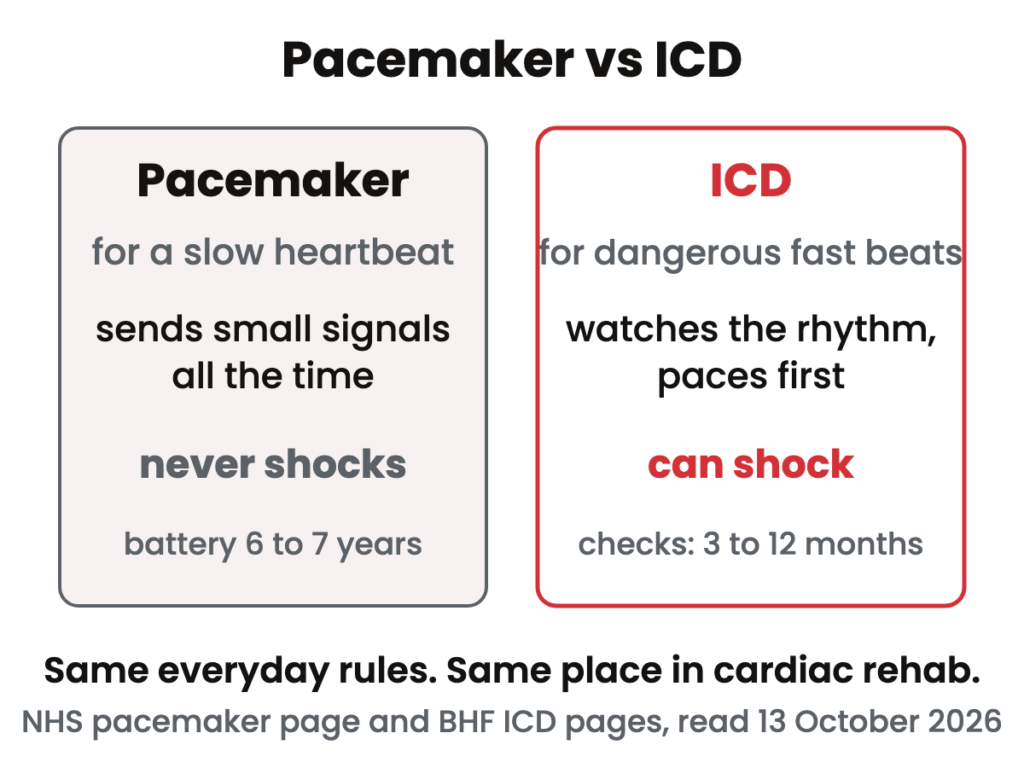
- A pacemaker treats a slow heartbeat and never shocks. An ICD treats dangerous fast rhythms and can shock.
- For 4 to 6 weeks after a pacemaker, the NHS says no heavy lifting and no elbow above the shoulder on that side.
- Phone 15 cm away. Induction stove 60 cm away. No TENS machine. Carry your device ID card.
- One shock and you feel fine: call your ICD clinic. One shock and unwell, or two or more shocks: emergency.
- In 8 trials with 1,730 people with an ICD, cardiac rehab raised fitness with no sign of more shocks.
Two devices, two jobs
Both devices sit under the skin of the chest, near the collarbone, with thin wires into the heart. Both are fitted under local anaesthetic, in about an hour for a pacemaker and 1 to 3 hours for an ICD. Most people go home the next day. From then on, the two do different jobs.
A pacemaker keeps a slow heart going
The NHS says a pacemaker treats heart block, other rhythm problems, and some heart failure. It sends a small electrical signal that gets the heart to pump, and keeps the beat steady. It never gives a shock. Some people with heart failure get a special pacemaker, called CRT, that makes the two sides of the heart beat together.
An ICD watches for dangerous fast rhythms
The British Heart Foundation (BHF) explains an ICD this way. It checks the heart rhythm all the time. If it sees a dangerous fast rhythm, it first sends a run of small, fast pulses to settle it. If that fails, it gives one or more shocks.
You may be offered an ICD after a cardiac arrest, after a dangerous rhythm, or if you are at risk of one. The risk is higher with heart disease, after a heart attack, and with heart failure. Some people with heart failure get a CRT-D, a heart failure pacemaker with a shock device built in.
The first six weeks
The NHS pacemaker page, reviewed in March 2026, gives the early rules. For the first few days you feel tired and the left side of the chest is sore. Gentle arm movements are fine. Keep the wound clean and do the shoulder exercises your care team gives you.
Then the four rules for weeks 1 to 6: do not drive for at least the first week, do not carry heavy things, do not do hard exercise, and do not lift the elbow on that side above the shoulder. Full recovery can take a few weeks or months. For an ICD, ask your care team how long the arm rules apply to you.
The BHF adds a sleeping tip for the ICD weeks: sleep on your back, or on the side away from the device, until the wound heals. A pillow under the arm helps. The wound usually heals in 3 to 4 weeks.
Check-ups and the battery
With a pacemaker, the NHS lists a check at about 6 weeks, one at 3 to 6 months, and then at least once a year. The battery usually lasts 6 to 7 years and is checked more often when the time is near. With an ICD, the BHF says checks come every 3 to 12 months, and many devices can send their data from home. Go even when you feel well.
Everyday rules that are the same for both
The BHF do’s and don’ts for an ICD, updated in August 2026, match the NHS pacemaker advice almost line for line. Most of the house is safe: microwaves, TVs, radios, electric drills and power tools. A few things need distance.
Keep the mobile phone at least 15 cm (6 inches) from the device, and never in a pocket over it. Use the other ear. Do not let headphones dangle over the chest. If a phone does get close, do not panic: the device goes back to normal when the phone moves away. With an induction stove, keep 60 cm (2 feet) between the device and the hob, and do not lean your chest over it.
Do not use a TENS machine for pain relief. Keep magnetic clasps and body-toning belts away from the device. Carry your device ID card.
At the airport, show the card and ask for a hand search. Staff should not hold a hand-held metal detector over the device. Electric cars are safe. When charging, keep 30 cm from the cable.
Driving rules differ by country, and your heart team tells you when you can drive again. Tell your insurer. Lorry, bus and commercial driving have stricter rules.
Sex is safe once the wound has healed. If an ICD shocked during sex, it would not harm your partner, who might feel a brief tingle. Many people go back to work. When depends on the kind of work.
Life with a pacemaker or an ICD: exercise
After the first six weeks, the picture changes. The NHS says a pacemaker should make being active easier, because the slow beat that held you back is gone. Walking is a good way to start, and the NHS says to build up slowly.
The BHF says being active with an ICD is usually encouraged. You may need to change or adapt some sports. Contact sports are usually out. Sports that raise the arm, like golf, are usually fine once you have healed.
The BHF then gives one line we agree with: cardiac rehab first, if you are offered it. It helps you rebuild confidence and fitness safely before you exercise more on your own. Always check with your heart team before a new or harder activity.
What we do differently for a device
At Cardiac Rehab in Hyderabad, people with a pacemaker or an ICD exercise under physician supervision, with the 12-lead ECG trace watched. An ICD is set to act above a certain heart rate. That number is in your device report, and your exercise plan keeps your heart rate below it, with a margin. A pacemaker has its own upper rate, and the plan respects that too. Bring the device report and your medicine list to the first visit.
The programme runs for 6 months: 90 minutes, 3 times a week, on Monday, Wednesday and Friday. It starts gently and gets harder as you get stronger. You learn your safe level with a doctor present, and then you carry it home.
The evidence
A 2019 Cochrane review pooled 8 trials of exercise based cardiac rehab in people with an ICD, 1,730 people in all. The programmes ran about 12 weeks. Fitness rose in the exercise groups. There was no sign of more shocks, more pacing by the device, or more serious problems in the people who exercised.
The trials were small and the evidence is rated low, so the reviewers call for bigger trials. Deaths were too few to judge. It is a promising answer, not a final one.
Many people with a device also have heart failure, and there the evidence is strong. A 2024 Cochrane review of 60 trials with 8,728 people found that those who did exercise based cardiac rehab went to hospital less in the first year: about 16 in 100, against 24 in 100 who did not exercise. European and US heart guidelines give exercise training in stable heart failure their highest grade, Class I, Level A.
What no study promises: that exercise will stop the next shock, or that it will make the device unnecessary. The device does its job. Cardiac rehab does a different one: it gets you fit and confident enough to live with it.
The shock, and the fear of it
A pacemaker never shocks, so this part is for people with an ICD. The BHF says a shock feels like a sudden jolt or thump in the chest or back. It can make you jump. Some people feel only a flutter, or nothing. It cannot shock a person touching you.
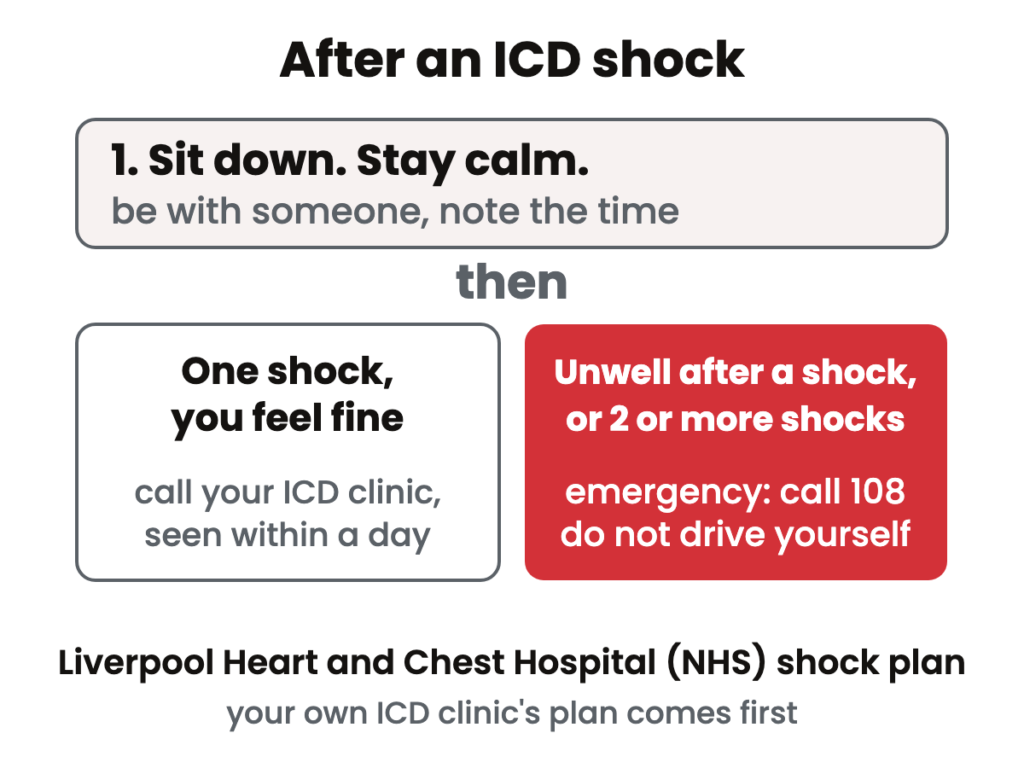
What to do next comes from the shock plan of the Liverpool Heart and Chest Hospital, an NHS centre. Sit down, stay calm, and be with someone if you can. Note the time and what you were doing, so the clinic has the details.
One shock and you feel fine: call your ICD clinic, and you will be seen the same or the next working day. One shock and you feel unwell, or two or more shocks: go to emergency. In India, call 108. Do not drive yourself.
Waiting for the next one
Dr Muralidar’s patients with an ICD often say the same thing: they feel the device is always there. A BHF clinical psychologist, Dr Anne-Marie Doyle, says the worry is a normal, healthy response to what has happened. After a shock, it can take days, weeks or months to feel calm again, and that too is normal. Some shocks turn out to be false alarms, when the device fired without need. The clinic can read the device and adjust it.
Her tips: talk to your ICD clinic about your worries. Set a daily “worry time” and write the worries down, then get on with the day. Distract yourself with music or something light. Try talking therapy if a shock was frightening. Her last tip is a cardiac rehab programme, where you get breathless on purpose, with a doctor watching, and learn that it is safe.
Your questions, answered
Can I exercise with a pacemaker?
Yes. The NHS says a pacemaker should make being active easier. For the first 4 to 6 weeks, no heavy lifting and no elbow above the shoulder on that side. After that, walking is a good start. Build up slowly, and follow your doctor’s advice on what is right for you.
Can I exercise with an ICD?
Most people can. The BHF says being active is usually encouraged. Avoid contact sports. Check with your heart team before anything new or harder. Cardiac rehab first, if you are offered it, is the BHF advice. Our plan keeps your heart rate below the rate at which the ICD is set to act.
What should I do after an ICD shock?
Sit down and stay calm. One shock and you feel fine: call your ICD clinic. One shock and you feel unwell, or two or more shocks: call 108. Do not drive yourself. Note the time and what you were doing, so the clinic has the details.
Can I use a mobile phone with a pacemaker or an ICD?
Yes. Keep it at least 15 cm (6 inches) from the device, use the other ear, and never carry it in a pocket over the device. If it gets close by mistake, the device returns to normal once the phone moves away.
Can I cook on an induction stove?
Yes, with distance. The BHF says to keep 60 cm (2 feet) between the device and the hob while it is on, and not to lean your chest over it. Use pans that fit the cooking zone. Microwaves, TVs, radios and power tools are safe to use as normal.
Can I fly and travel with a device?
Yes. Carry your device ID card and show it at airport security. Ask for a hand search. Staff should not hold a hand-held metal detector over the device. When you travel, carry extra medicines, your clinic’s contact details, and travel insurance that covers your heart condition.
Cardiac rehab with a pacemaker or an ICD in Hyderabad
Cardiac Rehab runs physician supervised, exercise based cardiac rehab at 7B Journalist Colony, Film Nagar, Jubilee Hills, Hyderabad. It is for people with a pacemaker or an ICD, with heart failure, and after a heart attack, a stent or a bypass. A doctor checks you first, and a first visit can be booked online. Write to info@cardiacrehab.com, visit www.CardiacRehab.com, or message us on WhatsApp. Many people later keep moving with Telangana Runners, our running community.
info@cardiacrehab.com · www.CardiacRehab.com
Cardiac Rehab, 7B Journalist Colony, Film Nagar, Jubilee Hills, Hyderabad, Telangana 500096
References
- NHS. Pacemakers. Page last reviewed 30 March 2026. nhs.uk/tests-and-treatments/pacemaker-implantation
- British Heart Foundation. Implantable cardioverter defibrillator (ICD). Published 6 May 2025. bhf.org.uk/informationsupport/treatments/implantable-cardioverter-defibrillator
- Giblin R. ICDs: do and don’ts when living with a defibrillator implant. British Heart Foundation, Heart Matters. Updated 10 August 2026. bhf.org.uk/informationsupport/heart-matters-magazine/medical/icd-tips
- British Heart Foundation. Adjusting to life with an ICD. Heart Matters. Published 25 February 2022. bhf.org.uk/informationsupport/heart-matters-magazine/medical/living-with-an-icd-implant
- Liverpool Heart and Chest Hospital NHS Foundation Trust. Implantable cardioverter defibrillator (ICD): shock plan. lhch.nhs.uk/implantable-cardioverter-defibrillator-icd—shock-plan
- Nielsen KM, et al. Exercise-based cardiac rehabilitation for adult patients with an implantable cardioverter defibrillator. Cochrane Database of Systematic Reviews. 2019. doi.org/10.1002/14651858.CD011828.pub2
- Molloy C, et al. Exercise-based cardiac rehabilitation for adults with heart failure. Cochrane Database of Systematic Reviews. 2024. doi.org/10.1002/14651858.CD003331.pub6