
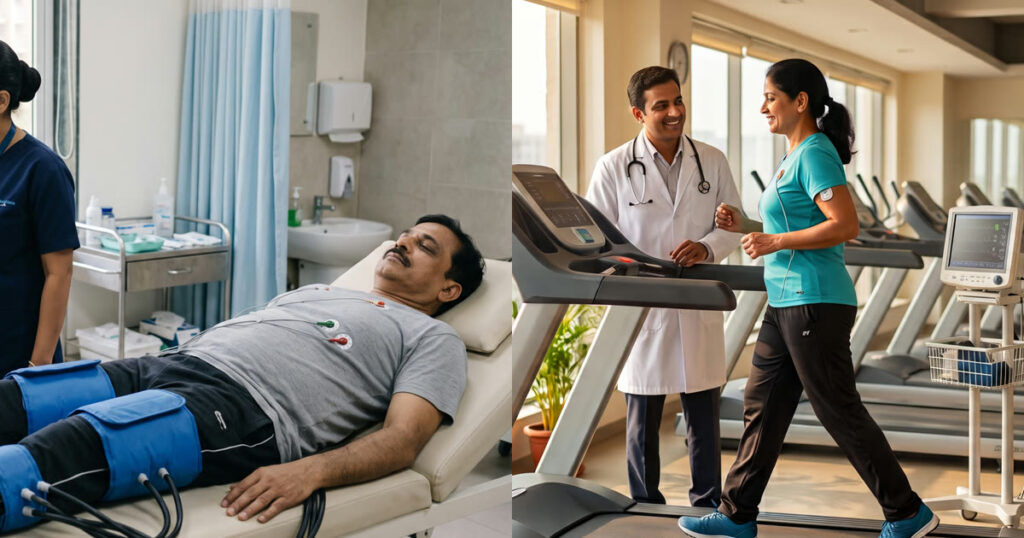
Short answer: EECP and cardiac rehab both try to ease chest pain and help you do more. In EECP, air cuffs passively squeeze blood up toward the heart while you lie still. In cardiac rehab, your leg muscles actively squeeze blood up toward the heart while you walk or jog, under physician supervision. Guidelines give cardiac rehab their highest grade, Class I, Level A. EECP is graded Class IIb, and is kept for people whose angina has no other treatment left.
In this article
- Part 1. What is EECP?
- Part 1. What is cardiac rehab?
- Part 2. Side by side: how they compare.
- Part 2. How long do the results last, and can I get back to work and recreational sport?
We do not offer EECP at Cardiac Rehab. This post is here so you can talk to your doctor with the facts.
What is EECP?
EECP is short for a long name: enhanced external counter pulsation. You lie still on a padded table. Air cuffs are wrapped around your calves, thighs and hips.

How a course runs. A heart trace (ECG) tells the machine when your heart is resting between beats. At that moment the cuffs fill with air. They passively squeeze blood up toward the heart, while you lie still. Just before the heart pumps again, the cuffs let go. Cleveland Clinic says the usual course is 35 hours: one hour a day, five days a week, for seven weeks.
Who it is for. The 2023 US guideline says EECP may be considered for one group. These are people whose chest pain has no other treatment left. That is Class IIb. The 2019 European guideline gave the same grade. The 2024 European update lists EECP only after all medicines and procedures have been tried.
Who should not have it. Cleveland Clinic lists:
- a leaky aortic valve,
- an irregular heartbeat called atrial fibrillation,
- blood clots,
- poor blood flow in the legs,
- pregnancy.
Common side effects are tiredness and aching muscles. Some people get blisters or sore skin from the cuffs.
What is cardiac rehab?
Cardiac rehab is exercise and advice for heart patients, under physician supervision. You walk or jog while your heart trace is watched.

How the programme runs. At Cardiac Rehab, it is a 6-month programme: 100 hours of intervention. Each session is 90 minutes, 3 times a week (Monday, Wednesday, Friday). After that, you keep a plan for life, so the gains stay.
What the muscles build. Your body already has a pump in your legs. When you walk or jog, your calf and thigh muscles tighten and relax. Each time, they actively squeeze blood up the veins toward the heart. Doctors call this the muscle pump. With steady training, the muscles change:
- More capillaries. These are the tiny blood vessels inside the muscle. More of them means more blood reaches each muscle fibre.
- More mitochondria. These are the parts of each cell that turn oxygen and food into energy.
- Better use of oxygen. So the same walk takes less effort, and the heart has less work to do.
A 2024 review pooled training studies in adults. Mitochondria went up by about 23 to 27%. Capillaries around each muscle fibre went up by about 10 to 15%. The first gains showed within 2 weeks.
What the guidelines say. Heart guidelines in the US (AHA and ACC) and Europe (ESC) agree. They give cardiac rehab their highest grade: Class I, Level A. A 2026 Cochrane review of 107 studies found 28% fewer heart attacks and 35% fewer hospital stays with cardiac rehab.
Side by side: how they compare
EECP is on the left, cardiac rehab on the right. On a phone, EECP comes first.
EECP
- How it works
- Air cuffs passively squeeze blood up toward the heart while you lie still.
- What you do
- Lie still on a table. The machine does the work.
- Who it is for
- Chest pain (angina) that has no other treatment left.
- Guideline grade
- Class IIb: “may be considered” (AHA and ACC 2023, ESC 2019).
- How long a course is
- 35 hours: 1 hour a day, 5 days a week, for 7 weeks.
Cardiac rehab
- How it works
- Your leg muscles actively squeeze blood up toward the heart while you walk or jog.
- What you do
- Walk or jog. Under physician supervision, your heart trace is watched.
- Who it is for
- Almost everyone after a heart attack, a stent or bypass, and people with heart failure.
- Guideline grade
- Class I, Level A: the highest grade (AHA, ACC and ESC).
- How long a course is
- A 6-month programme, 100 hours of intervention: 90 minutes, 3 times a week (Monday, Wednesday, Friday). Then a plan you keep for life.
How long do the results last, and can I get back to work and recreational sport?
EECP
- Chest pain
- In a large registry, 73 in 100 had less chest pain after the course. Most still had less pain 2 years later.
- A second course
- 18 in 100 needed a second course within 2 years.
- Fitness of the whole body
- In the PEECH trial, peak oxygen use (VO2) did not change overall. Walking time improved for some.
- Leg muscles
- In a small study, the muscles changed only a little, and not the way exercise changes them.
- Back to work
- We found no EECP study that measured this.
- Back to recreational sport
- We found no study.
Cardiac rehab
- Chest pain and heart events
- 28% fewer heart attacks and 35% fewer hospital stays (Cochrane review, 2026, 107 trials).
- Keeping it up
- In a 14-year study, people who kept up supervised exercise for over 3 years had a 33% lower risk of death.
- Fitness of the whole body
- Peak oxygen use (VO2) rose 3.4 units more than without exercise (2025 review, 33 trials). In 8,320 people, the gain was still there a year later.
- Leg muscles
- More mitochondria (about 23 to 27%) and more tiny blood vessels (about 10 to 15%), in a 2024 review.
- Back to work
- 66 in 100 went back to work, against 58 in 100 without rehab (2022 review, 16 studies). With outpatient rehab: 72 in 100.
- Back to recreational sport
- Cardiac rehab helps you take up recreational sport after the course.
Chest pain. For EECP, the relief often lasts. In a large registry, 73 in 100 people had less chest pain after the course, and this held at 2 years. Within those 2 years, 18 in 100 had a second course.
Whole-body fitness. Here the studies we read show little change with EECP. In the PEECH trial, peak oxygen use (VO2) did not change overall, though more people could walk a little longer. A small study looked inside the leg muscles. They changed only a little, and not in the way exercise training changes them.
Cardiac rehab builds fitness in the whole body. A 2025 review of 33 trials found peak oxygen use (VO2) rose 3.4 units more than without exercise. In a study of 8,320 people, the gain was still there a year later. In a 14-year study, people who kept up supervised exercise for over 3 years had a 33% lower risk of death.
Back to work. A 2022 review pooled 16 studies. 66 in 100 people who did cardiac rehab went back to work, against 58 in 100 who did not. With outpatient rehab, like ours, it was 72 in 100. A Cochrane review (2019) found rehab programmes may help more people return to work within 6 months. We found no EECP studies that measured return to work.
Back to recreational sport. We found no study that counted this for EECP. Cardiac rehab helps you take up recreational sport after the course.
To learn more, read our answer page: EECP or cardiac rehab: what is the difference?
Your questions, answered
Is EECP the same as cardiac rehab? No. In EECP, cuffs passively squeeze blood up while you lie still. In cardiac rehab, your muscles actively squeeze blood up while you walk or jog, under physician supervision. Cardiac rehab also teaches healthy habits and helps with worry.
Which has the stronger guideline grade? Cardiac rehab: Class I, Level A. EECP: Class IIb, and only for hard to treat angina.
Can I do both? Ask your heart doctor. EECP is a separate treatment that we do not offer. Cardiac rehab can be done alongside your other heart care.
Does cardiac rehab help angina? Yes. The 2024 European guideline says exercise should be offered to everyone with stable heart disease, which includes stable angina.
References
- Cleveland Clinic. EECP Therapy (Enhanced External Counterpulsation). my.clevelandclinic.org/health/treatments/16949
- 2023 AHA/ACC/ACCP/ASPC/NLA/PCNA Guideline for the Management of Patients With Chronic Coronary Disease. Circulation 2023. doi:10.1161/CIR.0000000000001168
- 2019 ESC Guidelines for the diagnosis and management of chronic coronary syndromes. Eur Heart J 2020;41:407–477.
- 2024 ESC Guidelines for the management of chronic coronary syndromes. Eur Heart J 2024;45:3415–3537.
- Arora RR et al. The multicenter study of enhanced external counterpulsation (MUST-EECP). J Am Coll Cardiol 1999;33:1833–40. PMID 10362181.
- Feldman AM et al. Enhanced external counterpulsation improves exercise tolerance in patients with chronic heart failure (PEECH). J Am Coll Cardiol 2006;48:1198–205. PMID 16979005.
- Michaels AD et al. Two-year outcomes after enhanced external counterpulsation for stable angina pectoris (International EECP Patient Registry). Am J Cardiol 2004;93:461–4. PMID 14969624.
- Michaels AD et al. Frequency and efficacy of repeat enhanced external counterpulsation for stable angina pectoris. Am J Cardiol 2005;95:394–7. PMID 15670552.
- Melin M et al. Effects of enhanced external counterpulsation on skeletal muscle gene expression in patients with severe heart failure. Clin Physiol Funct Imaging 2018;38:118–27. PMID 27782354.
- Mølmen KS, Almquist NW, Skattebo Ø. Effects of exercise training on mitochondrial and capillary growth in human skeletal muscle: a systematic review and meta-regression. Sports Med 2024.
- Collins BEG et al. The dose-response relationship of aerobic exercise on cardiorespiratory fitness in cardiac rehabilitation: a systematic review and meta-analysis. J Cardiopulm Rehabil Prev 2025;45:E53–E70. PMID 40638638.
- Ozemek C et al. Long-term maintenance of cardiorespiratory fitness gains after cardiac rehabilitation reduces mortality risk in patients with multimorbidity. J Cardiopulm Rehabil Prev 2023;43:109–14. PMID 36203224.
- Taylor C et al. Exercise dose and all-cause mortality within extended cardiac rehabilitation: a cohort study. Open Heart 2017;4:e000623. PMID 28878950.
- Cochrane review of exercise-based cardiac rehabilitation for coronary heart disease, 2026 update (see website/answers/sources.md).
- Sadeghi M et al. Prevalence of Return to Work in Cardiovascular Patients After Cardiac Rehabilitation: A Systematic Review and Meta-analysis. Curr Probl Cardiol 2022;47(7):100876. PMID 34034921.
- Hegewald J et al. Interventions to support return to work for people with coronary heart disease. Cochrane Database Syst Rev 2019;3:CD010748. PMID 30869157.