

Short answer: Diabetes and frequent urination go together, and most people know the washroom trips come from high sugar. Few know the one simple reason: sugar is hygroscopic. It pulls water to itself. When extra sugar spills into the urine, it drags water with it, and the bladder fills fast. The same pull works inside a muscle, where each gram of stored sugar holds about three grams of water.
In this article
- Glucose is hygroscopic: it pulls water to itself.
- With diabetes, sugar that spills into the urine drags water along. That is why you go so often and feel thirsty.
- Muscle stores sugar as glycogen, and each gram holds at least three grams of water.
- During aerobic exercise, muscle takes in up to five times more sugar, without insulin, for up to 48 hours after.
- A physician supervised exercise intervention trains the muscle to take that sugar in.
Diabetes and frequent urination: why does it happen?
When blood sugar is high, the kidney cannot hold all of it back, and sugar spills into the urine. Sugar in the urine is not alone. It pulls water with it. Doctors call this an osmotic diuresis. In the classic description, sugar made up about 60% of the particles in the urine of a person with very high blood sugar, and that person passed close to five litres of urine in a day.
The bladder itself does not pull the water. Its lining is built to be highly impermeable, a wall that keeps urine in. The pull happens higher up, in the kidney, where sugar and water travel together into the urine. The bladder only fills faster, so you go again and again. The water you lose makes you thirsty.
Sugar is a water magnet
The reason sits in one property of the molecule. Glucose is hygroscopic. The word means it attracts water from its surroundings and holds on to it. Sugar left open on a humid day goes damp for the same reason. Wherever sugar goes in the body, water follows.
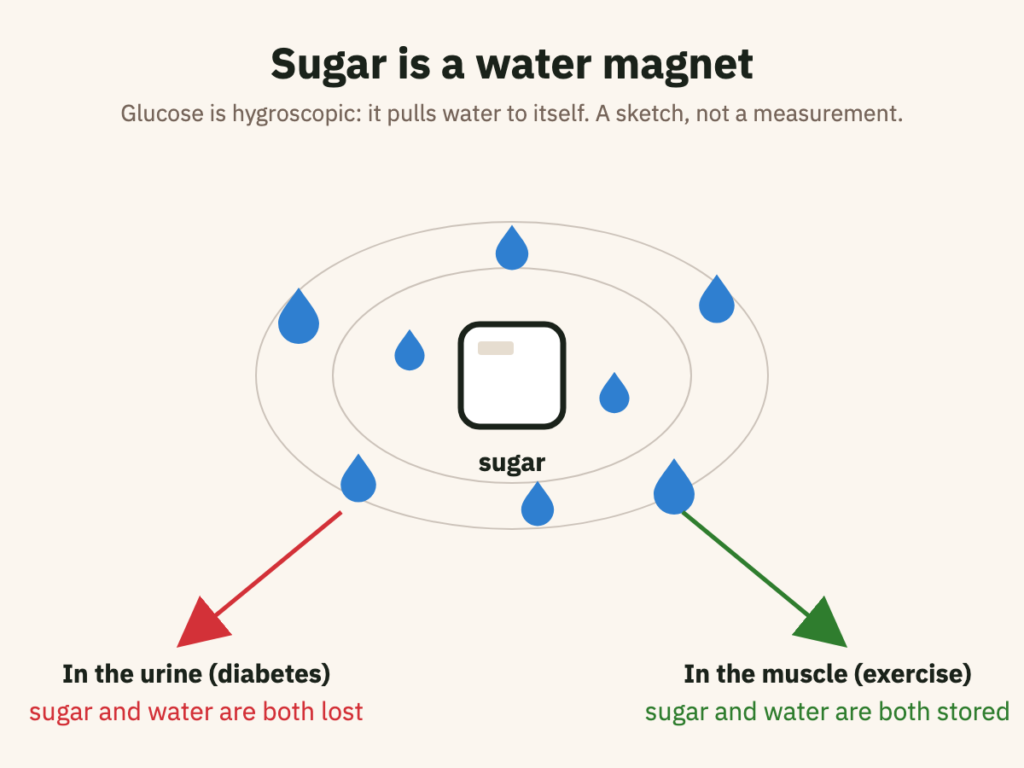
The same magnet works in your muscle
Muscle stores sugar in a packed form called glycogen. Because sugar pulls water, stored sugar is stored with water. In a study of recovering runners, each gram of glycogen came with at least three grams of water. An older review put the figure at three to four parts water for every part glycogen. Muscle as a whole is about three-quarters water and one-fifth protein.
This is one reason a trained muscle looks full and big. In the first weeks of weight training, part of the size gain is swelling and fluid, before much new protein has been built. Our Telangana Runners post looks at the gym side of this story: why muscles look fuller within weeks.
Exercise opens your muscle to sugar
Here is the part that matters for diabetes. The American Diabetes Association’s position statement says that during aerobic exercise, muscle takes in glucose up to five times faster than at rest, and it does this without insulin. The effect lasts for up to 48 hours after a long session, while the muscle refills its stores.
So the same sugar that would leave in the urine, dragging water with it, can instead be stored in the muscle, holding water there. Sugar and water always stay together in the body. Exercise decides where they go.
What this means for you
If you have diabetes and your washroom trips have gone up, the first step is to see your doctor and check your sugar. The second step is to give your muscles a reason to take sugar in. Steady aerobic exercise, done often, does that.
A physician supervised exercise intervention is built for this. At Cardiac Rehab it is physician supervised, exercise based cardiac rehab: the intensity is set and watched by a physician. The heart and the sugar are both kept safe while the muscle learns to store more.
Your questions, answered
Why do I pass so much urine with diabetes?
When blood sugar is high, the kidney cannot hold all the sugar back, and it spills into the urine. Sugar is hygroscopic, so it pulls water with it. Doctors call this an osmotic diuresis (Spira 1997). The bladder fills faster, so you go more often, and the water you lose makes you thirsty. If this has started or grown worse, see your doctor and check your sugar.
Does the bladder pull the water in?
No. The bladder lining is built as a tight wall that keeps urine in (Parsons 2007). The pull happens higher up, in the kidney, where sugar that cannot be held back carries water with it into the urine. The bladder only receives more urine than usual, so it fills faster. That is why the trips come so often with high sugar.
How much water does stored sugar hold in a muscle?
At least three grams of water for every gram of glycogen, measured in runners as their muscles refilled after a long run (Fernández-Elías 2015). An older review put it at three to four parts water for each part glycogen (Kreitzman 1992). So a muscle that stores more sugar also holds more water, and that is part of why a trained muscle looks full.
Can exercise lower my sugar without insulin?
During aerobic exercise, muscle takes in glucose up to five times faster, and the uptake does not need insulin. The effect can last up to 48 hours (ADA position statement, 2016). Ask your own doctor before you change any medicine.
Ask about a physician supervised exercise intervention
If you have diabetes, talk to your doctor about a physician supervised exercise intervention. The muscle learns to take sugar in, so less of it leaves in the urine. Read the gym side of the same story on Telangana Runners: why muscles look fuller within weeks.
info@cardiacrehab.com · www.CardiacRehab.com
Cardiac Rehab, 7B Journalist Colony, Film Nagar, Jubilee Hills, Hyderabad, Telangana 500096
References
- Spira A, et al. Osmotic diuresis: glucose-induced. Am J Kidney Dis. 1997. pubmed.ncbi.nlm.nih.gov/9398128
- Parsons CL. The role of the urinary epithelium in the pathogenesis of interstitial cystitis/prostatitis/urethritis. Urology. 2007. pubmed.ncbi.nlm.nih.gov/17462486
- PubChem. Glucose, compound summary (CID 5793): chemical and physical properties, hygroscopic. pubchem.ncbi.nlm.nih.gov/compound/5793
- Fernández-Elías VE, et al. Relationship between muscle water and glycogen recovery after prolonged exercise in the heat in humans. Eur J Appl Physiol. 2015. pubmed.ncbi.nlm.nih.gov/25911631
- Kreitzman SN, et al. Glycogen storage: illusions of easy weight loss, excessive weight regain, and distortions in estimates of body composition. Am J Clin Nutr. 1992. pubmed.ncbi.nlm.nih.gov/1615908
- Slater GJ, et al. Is an energy surplus required to maximize skeletal muscle hypertrophy associated with resistance training. Front Nutr. 2019. ncbi.nlm.nih.gov/pmc/articles/PMC6710320
- Damas F, et al. Early resistance training-induced increases in muscle cross-sectional area are concomitant with edema-induced muscle swelling. J Physiol. 2016. pubmed.ncbi.nlm.nih.gov/26280652
- Colberg SR, et al. Physical activity/exercise and diabetes: a position statement of the American Diabetes Association. Diabetes Care. 2016. pubmed.ncbi.nlm.nih.gov/27926890