
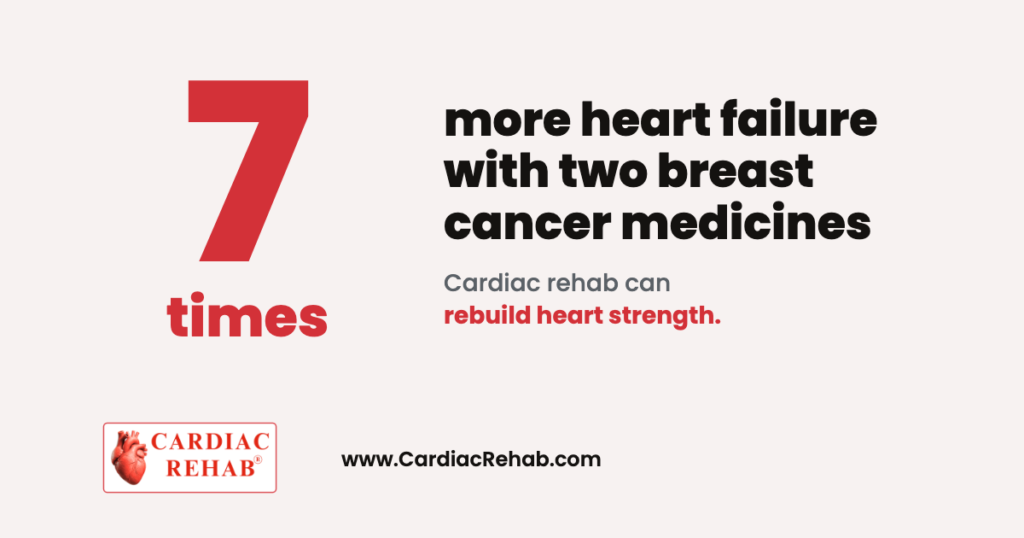
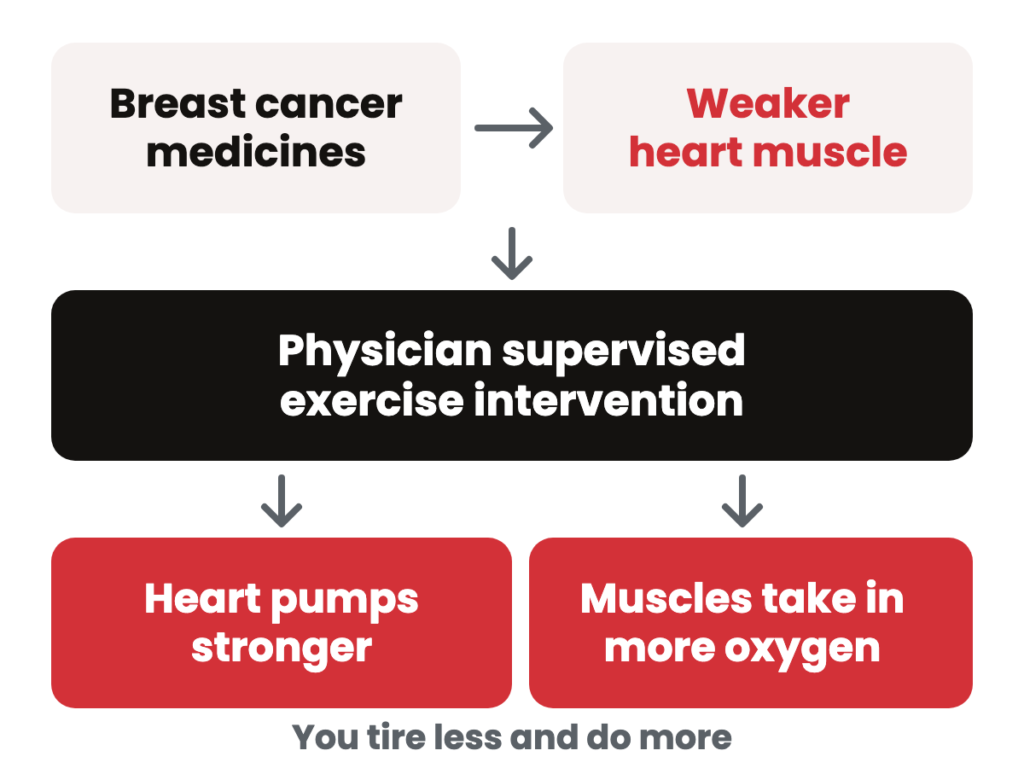
Short answer: Heart failure after breast cancer is more common than most women are told. Some breast cancer medicines can weaken the heart muscle. With two of them together, heart failure was 7 times more common than with no chemo. Cardiac rehab is a physician supervised exercise intervention. It makes the heart pump stronger and helps the muscles take in more oxygen.
In this article
- With two breast cancer medicines together, heart failure was 7 times more common than with no chemo.
- In one group of 433 women, almost half got heart failure over about 19 years.
- In women over 66, heart disease killed as many as breast cancer did.
- Our programme: 100 hours of physician supervised exercise intervention, 3 sessions a week, 90 minutes each.
- In cancer survivors, quality of life rose 14 points with cardiac rehab.
Can breast cancer medicines weaken the heart?
Some breast cancer medicines save lives but can weaken the heart muscle. Two of them are often given together: a common type of chemo, and a targeted medicine called trastuzumab. In a study of 12,500 women with breast cancer, heart failure was 7 times more common with the two together than with no chemo. With trastuzumab alone, it was about 4 times more common.
Heart failure means the heart muscle cannot pump as much blood as the body needs. You may feel short of breath or tired, or see swollen feet. These signs are easy to blame on the cancer treatment itself. That is one reason the heart is often missed.
How common is heart failure after breast cancer?
In one group of 433 women in Sweden, almost half got heart failure over about 19 years. These women were 18 to 60 years old when their cancer was found. The damage can stay silent for years. In a study of breast cancer survivors, the extra risk of death from heart disease showed up only about 7 years after diagnosis.
Age makes it weigh more. In women over 66 with breast cancer, heart disease killed as many as breast cancer did. For many older survivors, the heart becomes the bigger danger. Beating the cancer is the first win, and protecting the heart is the next one.
Why do so many survivors not know?
Many survivors say no one explained the heart risk to them. In interviews with breast cancer survivors, only about half had ever been given advice about their heart. Many were not sure of their own risk. The cancer team is focused, rightly, on the cancer.
Most patients, and even most doctors, do not know about cardiac rehab. Cancer patients are rarely sent to it. In India and around the world, it is still underused. This is what Dr Muralidar Babi sees in his clinic in Hyderabad.
How does cardiac rehab rebuild heart strength?
Cardiac rehab is a physician supervised exercise intervention. We provide a custom tailored, graded exercise program. At our centre that is 100 hours: 3 sessions a week, 90 minutes each. Before the first session we check your heart, and the physician sets the effort for you.
This exercise intervention makes the heart pump stronger. It also helps the muscles take in more oxygen, so the same walk feels easier. Cancer treatment can hit the heart, the blood vessels and the muscles together. Graded training works on all three, step by step.
What the trials show
In the CORE trial of cancer survivors, cardiac rehab raised oxygen use more than gym exercise did. Quality of life rose 14 points in the cardiac rehab group, against almost none in the gym group. In a trial during chemo, the cardiac rehab group’s heart pumped stronger at 6 months: 64% against 60%. That number is the share of blood the heart pumps out with each beat.
Who should ask about cardiac rehab after cancer?
Anyone who has had breast cancer medicines that can affect the heart should ask about it. It matters more if you are older, or have high blood pressure, diabetes or heart disease in the family. It also matters if you feel more tired or out of breath than before. Keep taking your medicines and keep seeing your cancer team. Physician supervised, exercise based cardiac rehab works alongside them.
Your questions, answered
Can chemo cause heart failure years later?
Yes, it can. Some breast cancer medicines can weaken the heart muscle, and the damage can stay silent for years. In one group of 433 women, almost half got heart failure over about 19 years. That is why survivors need their heart checked, even when they feel well after treatment.
Is exercise safe for my heart after cancer treatment?
It is safest when it is physician supervised. We check your heart first. Then the physician sets the effort, raises it step by step, and watches you during each session. This is why cardiac rehab is called an exercise intervention: it is planned and measured, not just a walk.
How long is the cardiac rehab programme?
At our centre, the programme is 100 hours. That is 3 sessions a week, 90 minutes each. Each plan is custom tailored and graded, so it starts where you are today. The effort goes up as your heart and muscles grow stronger, under physician supervision.
What results can cardiac rehab give cancer survivors?
In the CORE trial of cancer survivors, cardiac rehab raised oxygen use more than gym exercise did. Quality of life rose 14 points. In a trial during chemo, the cardiac rehab group’s heart pumped stronger at 6 months: 64% against 60%. Results differ from person to person.
Join cardiac rehab
Survived cancer? Rebuild your heart strength. Join cardiac rehab at Film Nagar, Jubilee Hills, Hyderabad. Write to info@cardiacrehab.com, visit www.CardiacRehab.com, or message us on WhatsApp. Finished the programme and want to keep going? Our runners show how in After breast cancer, rebuild your heart and your endurance on TelanganaRunners.com. You can also read how silent heart damage builds up.
info@cardiacrehab.com · www.CardiacRehab.com
Cardiac Rehab, 7B Journalist Colony, Film Nagar, Jubilee Hills, Hyderabad, Telangana 500096
References
- Bowles EJ, et al. Risk of heart failure in breast cancer patients after anthracycline and trastuzumab treatment: a retrospective cohort study. J Natl Cancer Inst. 2012. pubmed.ncbi.nlm.nih.gov/22949432
- Hubbert L, et al. Long-term and real-life incidence of cancer therapy-related cardiovascular toxicity in patients with breast cancer: a Swedish cohort study. Front Oncol. 2023. pubmed.ncbi.nlm.nih.gov/37152049
- Bradshaw PT, et al. Cardiovascular disease mortality among breast cancer survivors. Epidemiology. 2016. pubmed.ncbi.nlm.nih.gov/26414938
- Patnaik JL, et al. Cardiovascular disease competes with breast cancer as the leading cause of death for older females diagnosed with breast cancer. Breast Cancer Res. 2011. pubmed.ncbi.nlm.nih.gov/21689398
- Marrison ST, et al. Perception and counseling for cardiac health in breast cancer survivors using the Health Belief Model: qualitative analysis. JMIR Cancer. 2025. pubmed.ncbi.nlm.nih.gov/40609074
- Viamonte SG, et al. Cardio-oncology rehabilitation for cancer survivors with high cardiovascular risk: a randomized clinical trial (CORE). JAMA Cardiol. 2023. pubmed.ncbi.nlm.nih.gov/37819656
- Abdelhady SM, et al. Effect of cardiac rehabilitation program on left ventricular systolic function in patients with breast cancer receiving anthracycline-based chemotherapy. J Saudi Heart Assoc. 2025. pubmed.ncbi.nlm.nih.gov/40458660