
Short answer: To reduce HbA1c, treat blood glucose as an equation. Glucose enters the blood from food every day, and that cannot be stopped. The main way out is skeletal muscle, which handles about 80% of glucose uptake under insulin. In heart patients with diabetes, exercise based cardiac rehab lowered HbA1c by 0.47 points across 18 trials.
In this article
- Each 1% lower HbA1c: 14% fewer heart attacks, 21% fewer diabetes deaths, 37% fewer small-vessel problems.
- High blood glucose is not only about glucose going in. It is about glucose not going out.
- Skeletal muscle handles about 80% of glucose uptake under insulin.
- After one session, insulin works better for 48 hours. The effect is gone by 5 days.
- Cardiac rehab lowered HbA1c by 0.47 points in heart patients with diabetes.
Why does each point of HbA1c matter?
HbA1c is the blood test that shows how much glucose, the sugar in your blood, has been sitting there. In the UKPDS 35 study, each 1% lower HbA1c meant 14% fewer heart attacks (Stratton, BMJ, 2000). It also meant 21% fewer deaths from diabetes. And it meant 37% fewer small-vessel problems, the damage to tiny blood vessels in the eyes, kidneys and nerves.
For a heart patient, that first number matters most. Most advice to lower HbA1c is about food: eat less sugar. That advice is sound, but it works on only one side. The other side is where cardiac rehab works.
Is high glucose only about what goes in?
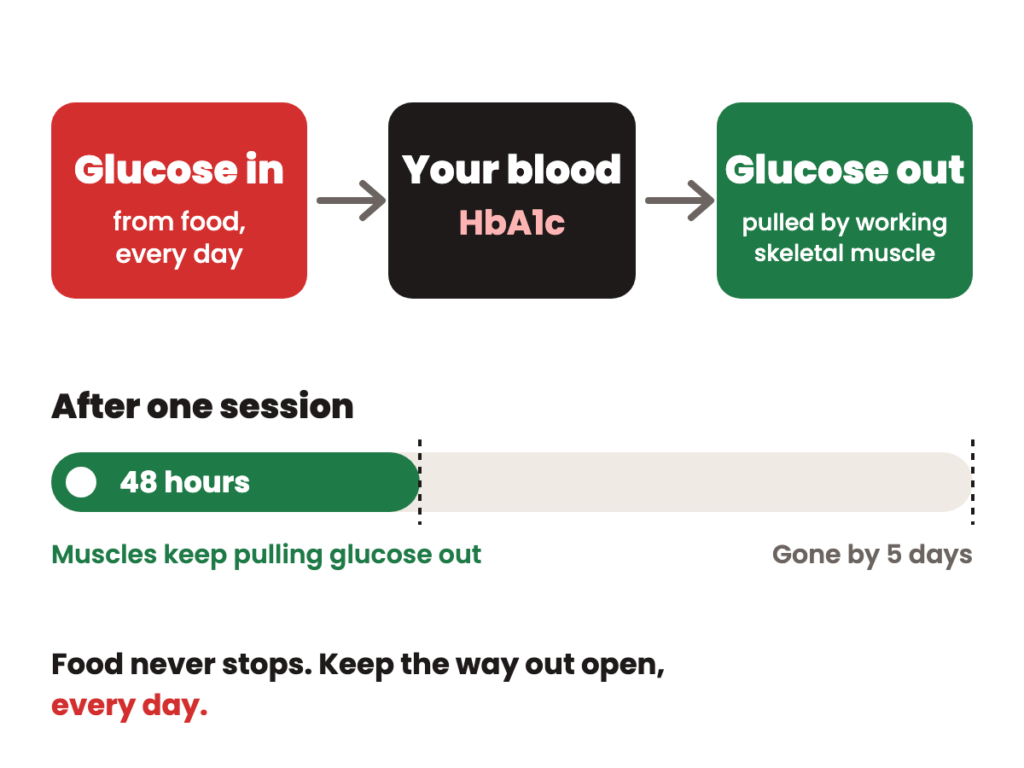
Think of blood glucose as an equation. Glucose enters the blood every day from food, and that cannot be stopped. Glucose leaves the blood when the body takes it up and uses it. Your HbA1c sits in the middle, set by both sides.
High blood glucose is not only about glucose going in. It is about glucose not going out. When the way out is slow, even a careful diet leaves glucose in the blood. So we ask a second question: how much glucose did your muscles use today?
How does exercise reduce HbA1c in the muscle?
Skeletal muscle, the muscle you move with, is the main exit. Under insulin, it handles about 80% of glucose uptake (DeFronzo and Tripathy, Diabetes Care, 2009). In type 2 diabetes, muscle stops answering insulin well, which is called insulin resistance. That is why the exit becomes slow.
Exercise opens a second route. A working muscle pulls glucose in even without insulin, through its own contraction (Santos, Int J Sports Med, 2008). So the muscle can clear glucose even when insulin is weak. This is the part that medicines alone cannot do for you.
Why one session is not enough
After one exercise session, insulin works better for about 48 hours (Mikines, Am J Physiol, 1988). By 5 days, the effect is gone. So one good session cannot fix your HbA1c. The exit has to be opened again every day or two, week after week.
What do the trials show?
In heart patients with diabetes, exercise based cardiac rehab lowered HbA1c by 0.47 points across 18 trials (Zhang, BMC Cardiovasc Disord, 2026). In people with type 2 diabetes, planned exercise lowered HbA1c by 0.67 points across 47 trials (Umpierre, JAMA, 2011). With more than 150 minutes a week, the fall was 0.89 points. These are results from a plan followed over weeks, not from a single walk.
Yet most heart patients with diabetes are never sent to a programme. They get tablets and diet advice, which work on the left side of the equation. The right side, the muscle, is left untrained. That gap is why this service exists.
Why physician supervised cardiac rehab?
Medicines help, and you should keep taking them. But exercise with heart disease and diabetes should start with a heart check and a physician watching. Physician supervised, exercise based cardiac rehab sets the workload, watches the heart and the glucose, and raises the effort step by step. Your doctor can then adjust your medicines as your HbA1c falls.
Your questions, answered
Can exercise reduce HbA1c in heart patients with diabetes?
Yes. In heart patients with diabetes, exercise based cardiac rehab lowered HbA1c by 0.47 points across 18 trials. Working muscle pulls glucose out of the blood, even when insulin works poorly. The benefit comes from a supervised plan followed for weeks, alongside your medicines, not instead of them.
How long does one exercise session help my glucose?
After one session, insulin works better for about 48 hours. By 5 days, the effect is gone. That is why cardiac rehab plans sessions through the week. Regular sessions keep the exit for glucose open, so the gains add up in your HbA1c over time.
Why is muscle so important for blood glucose?
Skeletal muscle handles about 80% of glucose uptake under insulin, so it is the main exit for glucose. In type 2 diabetes, muscle answers insulin poorly. But a working muscle can still take in glucose through its own contraction, which is why exercise helps when insulin does not.
Is it safe to exercise if I have heart disease and diabetes?
It is safest under supervision. Diabetes can hide heart symptoms, so we check the heart first. A physician then watches you during sessions and sets the effort for you. We also watch your glucose, so a low is caught early. Bring your latest HbA1c and your list of medicines.
Join cardiac rehab
Want to reduce your HbA1c under physician supervision? Join cardiac rehab at Film Nagar, Jubilee Hills, Hyderabad. We check your heart first, then build your muscles’ glucose use step by step. Write to info@cardiacrehab.com, visit www.CardiacRehab.com, or message us on WhatsApp. Already active and want to keep going after the programme? Our runners show how in A proven method to reduce your HbA1c. You can also read how cardiac rehab opens the sugar doors.
info@cardiacrehab.com · www.CardiacRehab.com
Cardiac Rehab, 7B Journalist Colony, Film Nagar, Jubilee Hills, Hyderabad, Telangana 500096
References
- Stratton IM, et al. Association of glycaemia with macrovascular and microvascular complications of type 2 diabetes (UKPDS 35). BMJ. 2000. doi.org/10.1136/bmj.321.7258.405
- DeFronzo RA, Tripathy D. Skeletal muscle insulin resistance is the primary defect in type 2 diabetes. Diabetes Care. 2009. doi.org/10.2337/dc09-S302
- Santos JM, et al. Skeletal muscle pathways of contraction-enhanced glucose uptake. Int J Sports Med. 2008. doi.org/10.1055/s-2008-1038404
- Mikines KJ, et al. Effect of physical exercise on sensitivity and responsiveness to insulin in humans. Am J Physiol. 1988. doi.org/10.1152/ajpendo.1988.254.3.E248
- Umpierre D, et al. Physical activity advice only or structured exercise training and association with HbA1c levels in type 2 diabetes. JAMA. 2011. doi.org/10.1001/jama.2011.576
- Zhang M, et al. Effects of exercise-based cardiac rehabilitation for coronary heart disease combined with diabetes mellitus: a systematic review and meta-analysis. BMC Cardiovasc Disord. 2026. doi.org/10.1186/s12872-026-05606-1